Run a 14-day performance review, make one controlled change, then track results over a 21-day window before judging impact. This cadence, paired with search-term-driven keyword harvesting and campaign health scoring, gives agencies a repeatable system instead of guesswork. AI-assisted platforms like Selloop.ai automate much of this measurement, which means faster insight, less wasted spend, and attribution you can actually trust.
TL;DR:
- Running a 14-day review and a 21-day tracking window ensures attribution accuracy and reduces premature reactivity in Amazon PPC campaigns.
- Automating report exports, anomaly detection, and change tracking with AI platforms streamlines campaign management and saves hours.
- Using one ASIN per campaign, tiered bids, and separating automatic from manual targeting maintains campaign clarity and scalability across multiple accounts.
- Focusing on one variable change at a time and waiting a full 21 days prevents misattributing performance results.
- Human oversight remains necessary for strategic hypothesis setting, final decision-making, and implementing key adjustments despite automation.
Table of Contents
- How the agency Amazon PPC workflow fits together
- Campaign and portfolio structure rules that scale
- Bidding rules that hold up under a biweekly review cycle
- Turning search term reports into a weekly harvesting routine
- Measuring impact over a 21-day window without confounding results
- What to automate, and what still needs a human
- Roles and handoffs that keep the workflow from breaking down
- Why discipline beats speed in Amazon PPC management
- How Selloop.ai puts this workflow into practice
- FAQ
- Sources
How the agency Amazon PPC workflow fits together
A disciplined workflow moves through six stages: plan and structure, launch, a 14-day performance review, a single controlled test or change, a 21-day tracking window, then iteration. Each stage feeds the next, so skipping the review or rushing the tracking window breaks attribution for every later decision.
The 14-day review lines up with how Amazon Ads recommends evaluating reports, since shorter windows rarely show stable trends. The 21-day tracking window follows because attribution and conversion lag need more time to settle before a change can be judged fairly.
This workflow spans three formats that interact rather than operate in isolation:
- Sponsored Products carries most conversion volume and is where bid tiering and keyword harvesting do the heaviest lifting.
- Sponsored Brands drives discovery and new-to-brand shoppers, feeding the top of the funnel that Sponsored Products later converts.
- Sponsored Display retargets and extends reach, often picking up shoppers who saw a Sponsored Products or Sponsored Brands ad but did not buy immediately.
Campaign and portfolio structure rules that scale
Structure determines whether a workflow survives contact with ten or a hundred client accounts. A few rules keep it consistent:
- Use one ASIN per campaign for hero products and anything with meaningful spend, since this isolates performance data and makes bid decisions unambiguous; group lower-volume or seasonal ASINs together to avoid managing dozens of near-empty campaigns.
- Build portfolios around budget caps and reporting groups, such as by brand, category, or client business unit, so a single dashboard view answers “where is spend going” without manual exports.
- Tier bids by match type within each ad group, with exact match carrying the highest bid, phrase in the middle, and broad the lowest, which avoids auction overlap and keeps spend predictable.
- Never mix targeting strategies in one ad group. Automatic and manual targeting belong in separate campaigns so search term data stays interpretable.
Agencies managing multiple client accounts often formalize these rules in a playbook for structuring campaigns at scale, which keeps new hires and freelancers aligned on naming and grouping conventions.
Bidding rules that hold up under a biweekly review cycle
Bidding works best as a hybrid: automation handles real-time adjustments, and human reviewers step in biweekly to shift strategy or budget. Dynamic bids - up and down can raise bids by up to 100% for placements more likely to convert, which makes it a strong default for sales-focused campaigns, high-performing ASINs, and deal-driven promotions where capturing the sale matters more than holding a fixed cost per click.
- Default to dynamic bids - up and down for established, conversion-focused campaigns.
- Reserve fixed bids for new launches or tightly controlled tests where you need a stable baseline.
- Adjust placement bids separately: raise top-of-search placement when conversion rate there clearly outperforms other placements, and lower it when it is burning budget without proportional sales.
Pro Tip: Review placement-level bid adjustments regularly alongside your main performance review, not as a separate ad-hoc task.
For a deeper breakdown of when to favor dynamic bids versus manual control, our bidding strategy guide walks through scenario-specific rules.
Turning search term reports into a weekly harvesting routine
Search term reports are the rawest, most useful data an account produces, and treating them as a routine rather than a one-time audit is what separates efficient accounts from wasteful ones.
- Export the search term report for each active campaign, automatic and manual alike.
- Promote high-converting queries into manual exact-match campaigns once they clear a minimum threshold of clicks and conversions worth trusting.
- Flag high-spend, non-converting queries and add them as negatives, scoped to the campaign or ad group level depending on whether the term is irrelevant everywhere or just in that context.
- Let automatic campaigns keep discovering new query variations, since their search term data regularly seeds manual keyword lists.
Avoid over-negating broad categories that still convert occasionally. A weekly cadence for this review, detailed in our keyword harvesting routine, keeps negative lists precise instead of bloated.
Measuring impact over a 21-day window without confounding results
The single biggest error in agency PPC work is changing three things at once and then guessing which one moved the needle. A sound testing practice is to change one variable, then observe for a full tracking window before judging results, since 21 days generally gives conversion and attribution data enough time to settle.
- Change exactly one strategic variable per test: a bid tier, a budget cap, or a targeting addition, never several together.
- Track sales and ROAS for conversion-focused tests, and track new-to-brand metrics alongside ROAS for discovery-focused Sponsored Brands tests.
- Hold the test steady for the full 21 days even if early numbers look promising or alarming, since short windows mislead.
- After 21 days, make one of three calls: scale the change, revert it, or run a focused follow-up test if results are ambiguous.
This decision rule removes the temptation to react to day-four noise and keeps every change attributable.
What to automate, and what still needs a human
Automation should absorb repetitive, high-frequency tasks: pulling reports, flagging anomalies, executing bulk bid edits, and surfacing negative keyword suggestions from search term data. Setting the hypothesis for a test and signing off on the final scale-or-revert decision should stay manual, since that judgment call is where strategy actually lives.
- Automate recurring report exports and anomaly alerts so reviewers start each cycle with a shortlist, not a raw spreadsheet.
- Automate bulk bid and budget edits once a strategy is approved.
- Keep hypothesis-setting, budget strategy shifts, and client-facing calls as human decisions.
Platforms built for this use campaign health scoring to flag underperforming accounts before a human ever opens a spreadsheet, which shortens the gap between a problem appearing and a reviewer acting on it.
Some platforms analyze campaigns for health scoring and automate the 21-day change tracking described above, pairing each recommendation with the data behind it. Agencies running multiple accounts often connect this kind of tool to Amazon’s reporting APIs for a single unified dashboard instead of toggling between consoles.
Roles and handoffs that keep the workflow from breaking down
A workflow only survives agency turnover if roles are explicit. Campaign setup and structure typically sit with a PPC specialist or freelancer; the 14-day review is owned by whoever manages the account day to day; test sign-off belongs to a lead or account manager who can weigh budget risk; and implementation of approved changes goes back to the specialist.
- Require a short handoff note before launching any test: the hypothesis, the metric being tracked, the expected direction, the owner, and the start date.
- Log the 21-day tracking window on a shared calendar so no one judges results early.
- Send clients a brief test-summary paragraph at the 21-day mark: what changed, what moved, and the next recommended step.
Formalizing this cuts down on the “why did we change this” conversations that waste review time, a pattern covered in our guide to managing multiple ad accounts.
Why discipline beats speed in Amazon PPC management
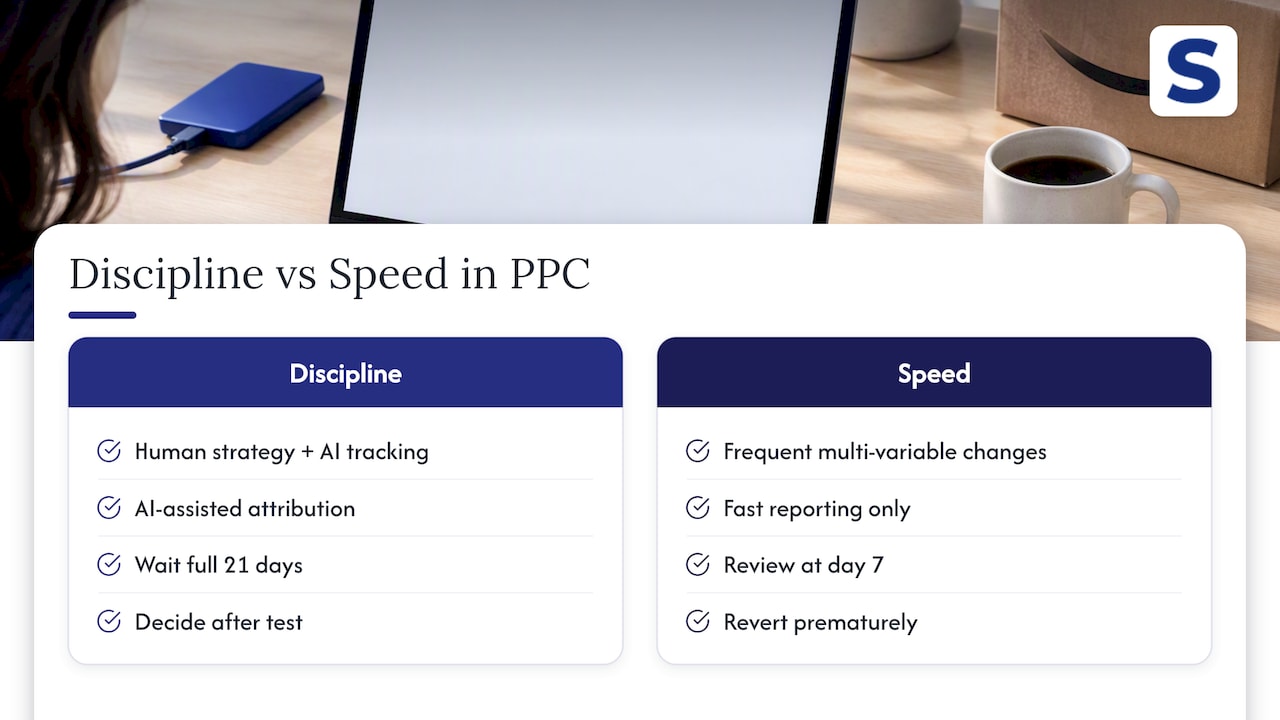
The agencies that scale profitably are not the ones making the most changes. They are the ones who resist the urge to touch five variables in one week and then wonder which one worked. Pairing human judgment on strategy with AI-assisted measurement on tracking is what actually improves attribution quality, not just reporting speed.
The most common error we see is reviewing a test at day seven, panicking at a soft number, and reverting before the data has settled. The fix is procedural, not clever: set the hypothesis, wait the full 21 days, then decide.
— Selloop
How Selloop.ai puts this workflow into practice
Running this workflow by hand across dozens of client accounts eats hours that should go toward strategy. Selloop.ai automates the measurement layer: it analyzes multiple campaigns at once, scores campaign health, and tracks every change over a 21-day window with a clear verdict tied to the data behind it, so reviewers spend their time on decisions instead of spreadsheets.
- Campaign health scoring flags high-spend, low-return campaigns before they drain budget further.
- Automated search term analysis surfaces keyword harvesting and negative keyword suggestions without a manual export.
- Customizable AI optimization profiles, conservative, balanced, or aggressive, match the risk tolerance of each account.
Plans run from STARTER at $29 per month up through PRO at $249 per month, with an AGENCIES & ENTERPRISE tier available on request. Start a free trial at Selloop to see the 21-day tracking in action on your own accounts.
FAQ
How often should agencies review Amazon PPC performance?
Amazon Ads recommends reviewing performance at least every 14 days, since shorter windows rarely show a reliable trend. Pair that review cadence with a 21-day tracking window for any specific change you test.
What is the 21-day tracking window for?
It is the observation period recommended for judging whether a single controlled change actually moved performance, based on Amazon Ads guidance on measuring campaigns. Changing only one variable and waiting the full window prevents misattributing results to the wrong cause.
When should I use dynamic bids versus fixed bids?
Dynamic bids - up and down work well for sales-focused campaigns and high-performing ASINs, since Amazon can raise bids by up to 100% for placements likely to convert. Fixed bids suit new launches or tightly controlled tests where a stable baseline matters more than chasing every conversion.
How do search term reports help with keyword harvesting?
Search term reports reveal which queries convert well enough to promote into manual campaigns and which ones drain budget without converting. Negative targeting can then be applied at the campaign or ad group level to cut the non-converting terms.
Does Selloop.ai replace the need for manual PPC reviews?
Selloop.ai automates reporting, health scoring, and 21-day change tracking, but strategic decisions like test hypotheses and final scale-or-revert calls still benefit from human review. It is built to remove the spreadsheet work around the STARTER, GROWTH, and PRO plans, not the judgment calls.