Your Amazon PPC bidding strategy determines not just how much you pay per click, but whether your ad budget actually builds a profitable business or quietly drains it. Amazon Sponsored Products campaigns offer four core bidding approaches: Dynamic Bids – Down Only, Dynamic Bids – Up and Down, Fixed Bids, and Rule-Based Bidding (Target ROAS). Each one makes a different deal with Amazon’s auction system, and picking the wrong one at the wrong stage of a campaign is one of the most common ways sellers burn through budget without seeing results.
The bid amount and the bidding strategy are two separate levers. Your bid sets the ceiling on what you’ll pay per click. Your strategy tells Amazon how much room it has to move that number in real time. Placement modifiers add a third layer, compounding on top of both. Understanding how these interact is what separates sellers who manage campaigns from sellers who just run them.
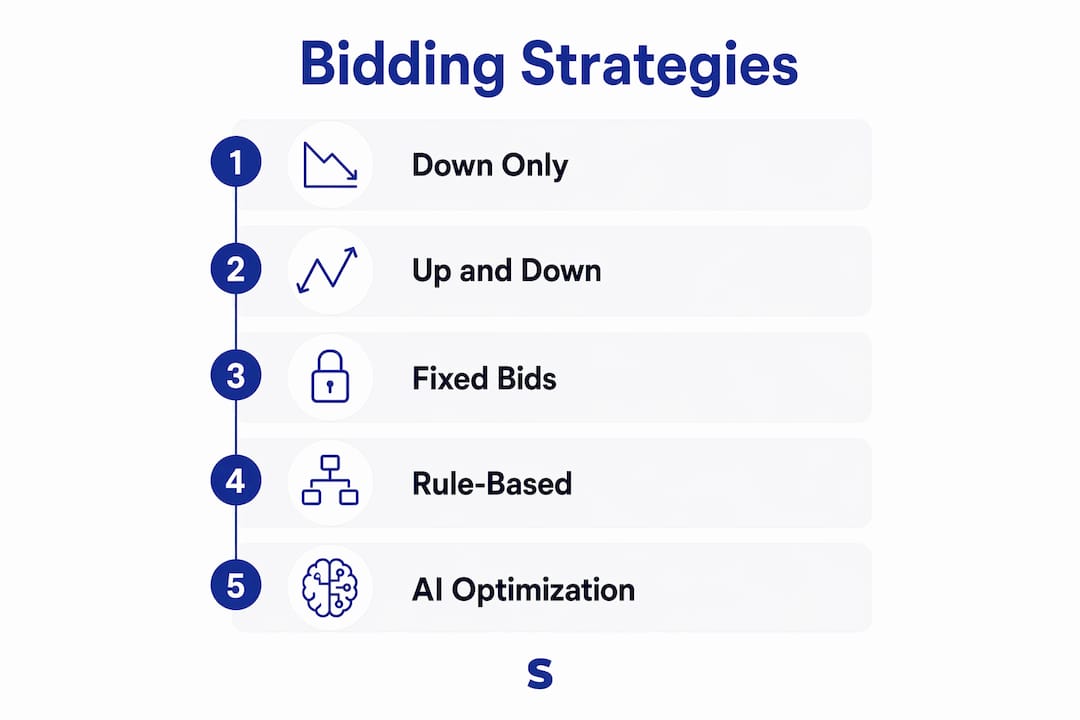
Here’s a quick reference for the four strategies:
- Dynamic Bids – Down Only: Amazon can lower your bid when conversion likelihood is low, but never raise it above your set amount. Best for launches and profitability-focused campaigns.
- Dynamic Bids – Up and Down: Amazon can raise your bid by up to 100% for high-converting placements and lower it for weak ones. Best for proven campaigns where revenue is the goal.
- Fixed Bids: Amazon uses your exact bid with no real-time adjustment. Best for controlled testing and clean data collection.
- Rule-Based Bidding (Target ROAS): Amazon adjusts bids automatically to hit a specific return on ad spend goal. Available for eligible Sponsored Products campaigns.
1. Dynamic bids – down only: the safest starting point
Down Only is the default strategy for a reason. Amazon can reduce your bid in real time when its algorithm judges a conversion unlikely, but it can never push your bid above what you set. Your bid functions as a hard ceiling on cost per click.

The practical benefit is straightforward: you avoid paying full price for low-intent traffic. During a product launch, Amazon has no conversion history to work from, so its predictions are unreliable. Down Only limits the damage from those early misfires while the algorithm learns what your listing actually converts on.
When to use Dynamic Bids – Down Only:
- New product launches with no conversion history
- Campaigns focused on profitability over volume
- Keyword harvesting phases where you want low realized CPC
- ASINs with thin margins where overspend is a real risk
- Auto campaigns running in discovery mode
One thing sellers often miss: Down Only for new campaigns is the recommended starting point precisely because Amazon’s conversion predictions improve over time. The strategy isn’t a permanent setting. It’s the right default until you have enough data to trust the algorithm with more flexibility.
2. Dynamic bids – up and down: when to turn on the accelerator
Up and Down gives Amazon permission to raise your bid by up to 100% when it predicts a high-converting click, and to lower it when it doesn’t. That means a $1.00 bid can become a $2.00 bid in a live auction, without you touching anything.

That flexibility is powerful in the right context and expensive in the wrong one. For campaigns with 60 or more days of conversion history running at or below target ACoS, Up and Down can capture high-intent traffic that Down Only would have passed on. For new campaigns, it frequently overbids on low-quality traffic and inflates ACoS fast because Amazon’s predictions aren’t calibrated yet.
The compounding effect with placement modifiers is where sellers get surprised. A top-of-search modifier of 50% combined with Up and Down bidding on a “likely to convert” auction can push your effective bid to 3.0x your base amount. That math happens automatically, and it happens fast.
Benefits and cautions:
- Maximizes impressions and sales on proven, high-converting keywords
- Works well during high-traffic events like Prime Day and Black Friday
- Ideal for campaigns featuring deal ASINs or excess inventory
- Risky for launches or campaigns with thin conversion history
- Always account for potential double spend when setting your base bid
Pro Tip: Before switching any campaign to Up and Down, check that your base bid already has a margin buffer built in. If your bid is set at break-even, Amazon’s upward adjustment will push you into unprofitable territory on every “likely” auction.
3. Fixed bids: predictability over performance
Fixed Bids remove Amazon’s real-time adjustment entirely. Whatever bid you enter is the bid Amazon uses, every time, for every auction. Placement modifiers still apply, but the dynamic layer is gone.
That sounds limiting, and for most production campaigns it is. Fixed bids leave conversions on the table because they can’t respond to high-intent signals. A shopper who is clearly ready to buy gets the same bid as one who is browsing.
Where Fixed Bids genuinely earn their place is in testing. When you want to understand the unmodified auction behavior of a new keyword set, or when you need clean, consistent spend data for reporting, the algorithm’s absence is an asset. You know exactly what you’re paying, and any performance differences you observe are attributable to the keyword or placement, not bid fluctuation.
Key uses and limitations:
- Controlled keyword testing where clean data matters
- Baseline measurement before introducing dynamic strategies
- Predictable spend forecasting for budget planning
- Not suited for scaling campaigns or maximizing conversion volume
- Placement modifiers still compound on top of the fixed amount
4. Rule-based bidding and Target ROAS
Rule-Based Bidding lets you set a specific Return on Ad Spend target and have Amazon adjust bids automatically to hit it. Instead of managing bids keyword by keyword, you tell Amazon the return you need, and the algorithm works backward from there.
This strategy is available only for Sponsored Products campaigns and works with automatic targeting, keyword targeting, and product targeting. It’s a step beyond dynamic bidding because you’re giving Amazon a revenue goal rather than just bid flexibility.
The advantage is direct: you’re optimizing for business outcomes rather than just click costs. The limitation is that Target ROAS requires enough conversion data to make reliable predictions. Campaigns without a solid history of sales will struggle to hit the target because the algorithm is guessing more than calculating.
When Rule-Based Bidding makes sense:
- Mature campaigns with consistent conversion history
- Sellers who want to automate bid management toward a revenue goal
- Accounts where manual bid adjustments have become too time-consuming
- Situations where ROAS is the primary campaign KPI
5. How placement and audience targeting shape your bids
Placement modifiers are additive. They increase your base bid by a percentage for a specific ad surface: top of search, rest of search, or product pages. Combined with a dynamic bidding strategy, they compound rather than simply add.
The math matters here. If your base bid is $1.00 and you set a top-of-search modifier of 50%, your bid at that placement becomes $1.50 before dynamic adjustments. With Up and Down bidding active, Amazon can then raise that $1.50 by up to 100%, reaching $3.00 on a single click. That’s why placement modifiers and bidding strategy need to be set together, not independently.
Conversion rates vary significantly by placement. Top of search typically outperforms rest of search and product pages, but “typically” doesn’t mean “always for your product.” Pull your placement report and look at actual conversion rate and ACoS by placement type before setting any modifier. If top of search converts at twice the rate of product pages for your specific ASINs, the modifier should reflect that math.
Bid allocation guidance by placement and audience:
- Set placement modifiers based on your own placement report data, not category averages
- Bid more aggressively for keywords that consistently attract new-to-brand customers
- Review top of search, product pages, and rest of search performance separately
- Reduce bids on placements that generate clicks but not sales
- For returning customers, conversion rates are often higher, which can justify a different bid posture
6. How to choose and optimize your Amazon PPC bidding strategy
The right bidding strategy depends on where your campaign is in its lifecycle, not on a universal best practice. A launch campaign and a mature exact-match campaign have completely different data profiles, and treating them the same way is a reliable path to wasted spend.
Start every new campaign on Down Only. After 60 or more days with stable ACoS at or below your target, consider graduating to Up and Down for your best-performing exact-match keywords. Keep auto discovery campaigns on Down Only indefinitely, since their purpose is finding terms, not maximizing spend on them.
Bid calculation should start with margin, not the ad console. The formula that experienced sellers use: Max ACoS = Gross Margin % minus Target EBITDA %. For a product with a 40% gross margin and a 15% profit target, the Max ACoS is 25%. From there, set your default bid at 70–80% of break-even to preserve room for placement multipliers, which can inflate CPCs by 50–900%.
Amazon’s suggested bids are category averages, not personalized recommendations. Starting bids 20–30% below the suggested figure consistently leads to better cost efficiency. If impressions don’t come, raise the bid incrementally until traffic starts flowing.
Campaign optimization workflow:
- Run auto campaigns at a controlled budget to discover converting search terms
- Pull the search term report weekly and graduate proven terms to manual exact-match campaigns
- Apply the bid adjustment formula when ACoS drifts: target ACoS divided by actual ACoS, multiplied by current bid
- Never adjust bids by more than 20% in a single pass.
- Keep auto campaigns below 20–30% of total PPC spend on mature accounts
When a keyword is generating sales but running above target ACoS, the instinct is to pause it. That’s usually the wrong move. Pausing a converting keyword disrupts the relevance signals Amazon uses for organic ranking. Reduce the bid incrementally by 15–20% instead, wait a week, then reassess.
Pro Tip: Review bids on a weekly cadence. Daily changes introduce noise the algorithm can’t respond to meaningfully. Monthly reviews let problems compound for too long. Weekly is the cadence that keeps you close enough to catch issues while giving Amazon’s system time to register the change.
7. Advanced optimization with AI-powered Amazon PPC management
Manual bid management works at small scale. Across hundreds of keywords and multiple campaigns, the lag between data and decision becomes a real cost. By the time you’ve pulled reports, identified the issue, and made the change, the marketplace has already shifted.
AI-powered tools address this by analyzing margin, inventory status, and campaign data continuously, then adjusting bids without waiting for a weekly review. The key difference from basic automation is that effective AI logic incorporates business constraints, not just ad performance signals. A keyword that converts well but is attached to an ASIN approaching a low-inventory surcharge deserves a lower bid, not a higher one.
Inventory awareness is one of the most overlooked factors in bid decisions. Amazon’s low-inventory surcharge can materially change the economics of a campaign, and sellers who don’t reduce bids as stock tightens risk accelerating their own sell-through into a worse margin position. An AI tool that reads inventory status alongside ad performance catches this before it becomes a problem.
Selloop’s platform is built around exactly this kind of margin-aware optimization. It analyzes Sponsored Products and Sponsored Brands campaigns, identifies where budget is being wasted, and provides data-backed recommendations on which bids to adjust, which keywords to harvest, and which search terms to negate. Sellers approve each change with one click, Selloop applies it on Amazon, and then tracks the result over a 21-day window to confirm whether it actually worked. That tracking window is what separates informed optimization from guesswork.
AI optimization benefits for Amazon PPC:
- Continuous bid adjustment based on margin, inventory, and conversion data
- Automated keyword harvesting and negative keyword suggestions
- Campaign health scoring to prioritize where attention is needed most
- 21-day result tracking to verify whether bid changes actually improved performance
- Customizable optimization profiles (conservative, balanced, aggressive) to match your risk tolerance
- Smart alerts that flag underperforming campaigns before they drain budget
8. Understanding bid adjustments and their impact on ad performance
A bid adjustment is any change to your base bid, whether made manually, by Amazon’s dynamic system, or by a placement modifier. The impact on ad performance depends on the direction, size, and timing of the adjustment.
Raising a bid increases your chances of winning the auction and appearing in higher-visibility placements. It also raises your cost per click, which directly affects ACoS. The question is never whether a higher bid gets more clicks. It’s whether those clicks convert at a rate that justifies the cost. That answer lives in your placement and search term reports, not in the bid interface.
Lowering a bid reduces CPC but also reduces impression share. The risk is losing visibility on keywords that were driving organic ranking signals alongside paid sales. This is why incremental reductions of 15–20% are the standard approach rather than sharp cuts. A gradual reduction lets you find the bid floor where traffic continues without the overpay.
Placement modifiers compound with dynamic bid adjustments in ways that aren’t always obvious from the campaign settings screen. A seller who sets a 50% top-of-search modifier and then switches to Up and Down bidding without recalculating their base bid is effectively doubling their exposure to high CPCs. The adjustment doesn’t override the modifier. Both apply simultaneously.
9. Analyzing bid strategy performance metrics and KPIs
ACoS is the most watched metric in Amazon PPC, and it should be, but it tells only part of the story. A 40% ACoS on a keyword driving strong organic rank lift is a different situation than a 40% ACoS on a keyword with no halo effect. Context matters.
The metrics that give you a complete picture of bid strategy performance:
- ACoS (Advertising Cost of Sale): Ad spend divided by ad revenue. Your primary efficiency signal.
- TACoS (Total Advertising Cost of Sale): Ad spend divided by total revenue, including organic. Shows whether PPC is lifting the whole business or just paying for itself.
- CPC (Cost Per Click): Tracks whether bid adjustments are actually changing what you pay in auctions.
- Conversion rate: The denominator in every bid calculation. If it drops, your bids need to follow.
- Impression share: A sudden drop signals that a bid reduction went too far or that competition increased.
- ROAS: The inverse of ACoS. Useful when reporting to stakeholders who think in revenue terms.
Review these metrics at the keyword level, not just the campaign level. A campaign running at target ACoS can contain keywords at 10% ACoS and keywords at 120% ACoS that cancel each other out. The campaign average hides the problem. Sorting by spend and then by ACoS within each campaign is the fastest way to find where the budget is actually going.
10. Using automated bidding tools and machine learning for Amazon PPC
Amazon’s built-in bidding strategies provide a foundation, but they operate on ad performance signals alone. They don’t know your gross margin, your inventory position, or your cross-channel commitments. That gap is where automated PPC management tools add real value, by integrating business logic with bid decisions.
Machine learning improves bid accuracy by processing more signals than any manual review can handle. Conversion rate by time of day, placement performance by keyword, search term relevance shifts, competitor bid changes. A well-trained model adjusts bids in response to all of these simultaneously, not sequentially.
The practical benefit for sellers is speed. Manual bid management on a large account requires pulling reports, analyzing data, making changes, and then waiting to see results. That cycle typically takes a week or more. An automated tool running on a daily or hourly basis compresses that cycle significantly, catching problems and opportunities before they compound.
For sellers exploring Amazon advertising AI tools, the key question is whether the tool incorporates margin and inventory data or just optimizes for ACoS. A tool that drives ACoS down by cutting bids on every keyword above target will eventually hurt organic ranking and long-term profitability. The better tools understand that some above-target ACoS is acceptable when the keyword is driving ranking, and they adjust accordingly.
11. Budget allocation strategies related to bidding
Budget and bids are connected more tightly than most sellers realize. A campaign that runs out of budget at noon is effectively bidding zero for the rest of the day, regardless of what the bid settings say. Budget constraints shape realized bid performance as much as the bid amounts themselves.
For mature accounts, a useful benchmark: auto campaigns running above 20–30% of total PPC spend usually signal that budget is drifting toward discovery at the expense of controlled, profitable traffic. That’s not a hard rule, but it’s a reliable warning sign that the account structure needs rebalancing toward proven exact-match campaigns.
Allocate budget in proportion to proven performance, not evenly across campaigns. Your best-converting exact-match campaigns should rarely be budget-constrained. Auto and broad campaigns, which are still in discovery mode, should run at a controlled budget that limits exposure while still generating data.
During high-traffic events like Prime Day and Black Friday, competition increases and CPCs rise. Sellers who want to maintain visibility during these periods typically increase both bids and budgets. The risk is overspending on traffic that converts at normal rates but costs significantly more. Set a ceiling on how much you’re willing to pay per click during these events and monitor ACoS daily rather than weekly.
12. Common mistakes and pitfalls in Amazon PPC bidding strategies
The most expensive mistake in Amazon PPC bidding is switching to Up and Down bidding before a campaign has enough conversion history. Amazon’s algorithm needs data to make reliable predictions. Without it, the system overbids on low-quality traffic and inflates ACoS in ways that are hard to reverse quickly.
Pausing converting keywords when ACoS spikes is the second most common error. The instinct makes sense, but the consequence is real: pausing disrupts the relevance signals that feed organic ranking, and rebuilding that momentum takes time. Incremental bid reductions preserve the traffic signal while bringing costs down.
Trusting Amazon’s suggested bids at face value is a subtler problem. Those figures represent category averages, not what’s optimal for your specific product and margin structure. Starting 20–30% below the suggestion and adjusting upward based on actual impression data is consistently more efficient than accepting the default.
Other pitfalls to avoid:
- Setting placement modifiers without checking your own placement-level conversion data first
- Applying the same bid strategy across all campaigns regardless of their maturity or purpose
- Making bid changes more frequently than weekly, which introduces noise the algorithm can’t process
- Ignoring inventory status when setting bids, especially as stock tightens
- Running auto campaigns without separating close match, loose match, substitutes, and complements into individual bids
- Treating TACoS and ACoS as interchangeable when they measure fundamentally different things
One more: relying on a single optimization tool without understanding the logic behind its recommendations. Automation alone won’t guarantee profits. Successful bidding combines business margin logic with technology. A tool that optimizes for ACoS without knowing your gross margin can drive you toward efficiency on paper and losses in practice.
Try Selloop for smarter Amazon PPC bid management
Selloop is built for Amazon sellers who want the benefits of AI-driven bid optimization without the complexity of enterprise-level tools or agency pricing. The platform analyzes your Sponsored Products campaigns, identifies where budget is being wasted, and gives you clear, data-backed recommendations on which bids to adjust, which keywords to harvest, and which search terms to negate.
Every recommendation comes with the data behind it. You approve each change with one click, Selloop applies it on Amazon, and tracks the result over 21 days so you can see exactly what worked. Plans start at €29/month with a 7-day free trial.
Start your free trial and see where your ad budget is actually going.
Key Takeaways
The most effective Amazon PPC bidding strategy matches your campaign’s maturity to the right bid type, uses margin-aware bid calculation, and treats bid adjustments as a weekly discipline rather than a one-time setup.
| Point | Details |
|---|---|
| Start with Down Only | New campaigns should use Dynamic Bids – Down Only until they have 60+ days of stable conversion data. |
| Set bids below break-even | Default bids at 70–80% of break-even protect margin against placement multipliers, which can inflate CPCs by 50% up to 900%. |
| Never pause converting keywords | Reduce bids incrementally by 15–20% instead of pausing, to preserve organic ranking signals. |
| Start below suggested bids | Amazon’s suggested bids lean high; starting 20–30% below and adjusting upward delivers better cost efficiency. |
| Integrate inventory into bid decisions | Bids should reflect inventory status, not just ad performance, to avoid accelerating sell-through at worse margins. |