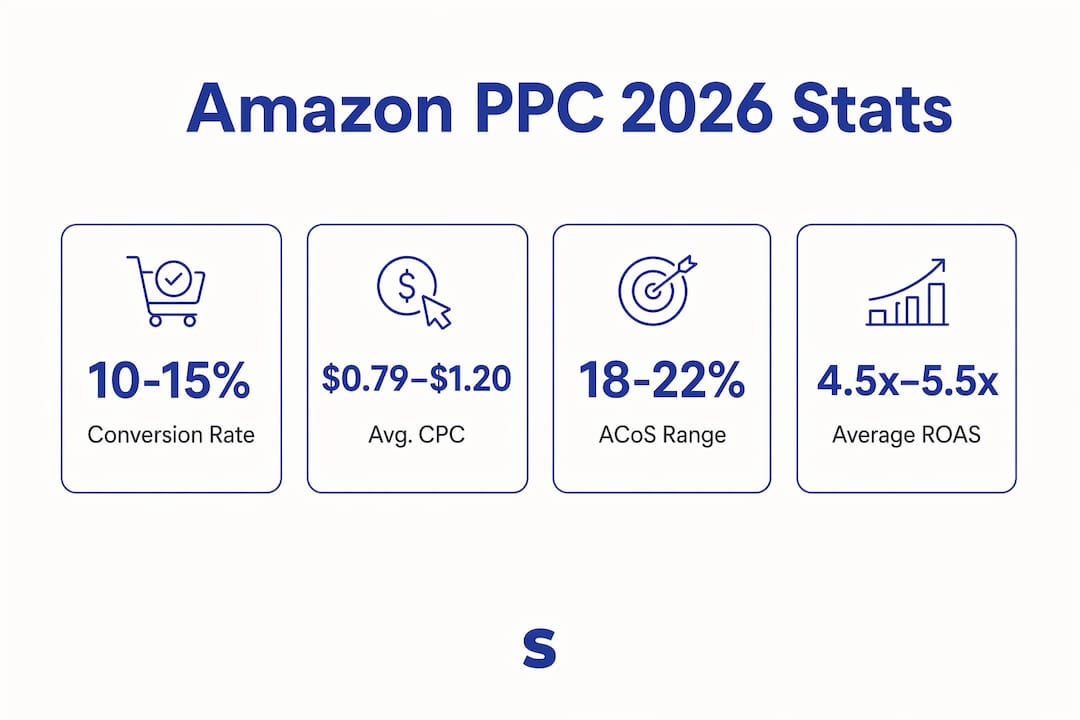
Amazon Pay-Per-Click advertising is the most direct path to page-one visibility on the world’s largest product search engine, and for most sellers, it is worth the investment when managed with precision. Median ROAS sits at 4.5x–5.5x across all categories in 2026, with established accounts running an Advertising Cost of Sale (ACoS) of 18–22%. That means for every dollar spent on ads, well-run accounts return four to five dollars in revenue. The catch is that “well-run” is doing a lot of work in that sentence. Rising cost-per-click (CPC) rates, a new 3.5% FBA surcharge introduced in april 2026, and intensifying competition mean that sellers who treat Amazon PPC as a set-and-forget channel will lose money. Sellers who treat it as a data-driven profit center will grow.
Is Amazon PPC worth it? Key benchmarks for 2026
The answer starts with the numbers. Amazon PPC conversion rates average 10–15%, which dwarfs typical direct-to-consumer websites that convert at 1–2%. That gap reflects buyer intent. Shoppers on Amazon are already in purchase mode. They are not browsing for inspiration; they are comparing products and reaching for their wallets.
Average CPC ranges from $0.79 to $1.20 across most categories, but competitive niches like supplements, electronics, and home goods regularly exceed $5 per click. Margin math matters here. A $1 CPC with a 12% conversion rate and a $30 product at 40% margin is profitable. That same $1 CPC on a $15 product at 20% margin is not.
The table below shows how performance varies by category, giving sellers a realistic baseline for evaluating their own campaigns.
| Category | Avg. CPC | Conversion Rate | Typical ROAS |
|---|---|---|---|
| Home & Kitchen | $0.85–$1.10 | 12–15% | 4.8x–5.5x |
| Health & Beauty | $1.00–$1.50 | 10–13% | 4.5x–5.2x |
| Electronics | $1.50–$3.00 | 8–11% | 3.8x–4.5x |
| Supplements | $2.00–$5.00+ | 10–14% | 4.0x–5.0x |
| Apparel | $0.80–$1.20 | 9–12% | 4.2x–5.0x |
New product launches or aggressive growth campaigns can push ACoS to 40–60% before optimization takes hold. That is not a failure signal. It is the cost of building sales velocity and review count, both of which feed Amazon’s A9 algorithm and improve organic ranking over time.
How has the Amazon PPC landscape changed in 2026?
The biggest shift in 2026 is cost pressure from two directions at once. CPCs have climbed steadily as more brands enter the marketplace, and the 3.5% FBA surcharge introduced in april 2026 has squeezed margins further. Sellers who built their unit economics on 2023 or 2024 cost assumptions need to recalculate.
The second shift is algorithmic. The old “spray-and-pray” approach, running broad match campaigns across every keyword and hoping something converts, is now a reliable way to burn budget. Modern Amazon algorithms favor segmented campaigns, weekly negative keyword management, and listing quality. Precision in campaign structure directly correlates with profitable returns.
The practical implications for sellers include:
- Page-one placement now requires PPC. Organic ranking alone rarely delivers new product visibility in competitive categories.
- Listing quality gates ad performance. A poorly written title, weak images, or thin bullet points will drag down conversion rates regardless of ad spend.
- Negative keyword management is not optional. Unreviewed broad and phrase match campaigns bleed budget on irrelevant searches within days.
- Budget allocation must reflect margin, not revenue. Sellers chasing top-line sales without tracking contribution margin will misread their results.
Pro Tip: Before scaling ad spend, audit your listing against the top three organic results in your category. If your images, title, and reviews do not match that standard, fix the listing first. Ad spend on a weak listing accelerates losses, not sales.
How do sellers optimize Amazon PPC campaigns for maximum profitability?
Profitable Amazon PPC management follows a repeatable process. The sellers who win are not necessarily spending more. They are spending smarter, with tighter campaign structures and faster feedback loops.
- Segment campaigns by product, match type, and audience. Running exact, phrase, and broad match keywords in the same campaign makes it impossible to control bids by intent level. Separate them from day one.
- Review negative keywords weekly. Search term reports reveal irrelevant queries burning budget. Adding negatives weekly is the single fastest way to reduce wasted spend without cutting reach.
- Align bids with unit economics. Calculate your break-even ACoS before setting bids. If your product margin is 35%, your break-even ACoS is 35%. Bids that push ACoS above that number cost you money on every sale.
- Use PPC to build organic rank, then track TACoS. Total Advertising Cost of Sale (TACoS) measures ad spend against total revenue, including organic sales. A rising organic share with stable TACoS means PPC is working as intended, building rank and reducing long-term ad dependency.
- Test video and Sponsored Brand ads early. Video ads consistently outperform static creatives in engagement metrics. Early adoption in less saturated ad formats gives sellers a cost advantage before competitors follow.
- Monitor the 21-day impact window. Bid changes and keyword additions take time to register in performance data. Evaluating results before three weeks of data accumulate leads to premature decisions and constant campaign churn.
PPC drives organic ranking by generating the sales velocity Amazon’s A9 algorithm needs to surface products in unpaid results. Relying on organic traffic alone for a new product launch is not a strategy. It is a waiting game with no guaranteed outcome.
Pro Tip: Track true incremental sales lift, not just last-click ROAS. If your organic sales rise alongside paid sales, your PPC is doing double duty. That combined signal is the real measure of campaign health.
How does Amazon PPC compare to other digital advertising channels?
Amazon PPC outperforms most digital channels on the metric that matters most: purchase intent. Google Ads delivers 2–5% conversion rates with CPCs that regularly exceed $5 in competitive categories. Facebook Ads convert at 1–3% with CPCs of $1–$2. Amazon’s 10–15% conversion rate at $0.79–$1.20 average CPC is a fundamentally different economics equation.
The reason is context. A shopper clicking an Amazon Sponsored Product ad has already typed a product query into a marketplace. A shopper clicking a Facebook ad was watching a video about something else entirely. Intent is not equal, and intent is what drives conversion.
That said, other channels outperform Amazon PPC in specific scenarios.
| Channel | Avg. CPC | Conversion Rate | Best Use Case |
|---|---|---|---|
| Amazon PPC | $0.79–$1.20 | 10–15% | High-intent product searches |
| Google Ads | $2.00–$5.00+ | 2–5% | Brand search, research-phase buyers |
| Facebook/Instagram Ads | $1.00–$2.00 | 1–3% | Impulse purchases, brand awareness |
Products that require significant consumer education, like complex software tools or novel health devices, often perform better with Google or social ads that allow longer narrative formats. Impulse purchases with strong visual appeal can thrive on Instagram. Amazon PPC is the right channel when the product category already has search demand and buyers know what they want.
When is Amazon PPC worth the investment and when is it not?
Amazon PPC delivers returns under specific conditions. Sellers who meet these criteria consistently see positive ROI. Those who do not will struggle regardless of how much they spend.
Conditions that support profitable PPC:
- Product margin above 30% after FBA fees, COGS, and the new 3.5% surcharge
- At least 15 reviews with a 4.0-star rating or higher
- A listing with optimized title, A+ content, and professional images
- A price point competitive within the top five results for the target keyword
- A defined break-even ACoS before the first campaign goes live
Red flags that predict poor returns:
- Thin margins below 20% that leave no room for ad cost
- Fewer than ten reviews or a rating below 3.8 stars
- Unoptimized listings with low organic conversion rates
- Poor-converting listings accelerate losses when ad traffic is added
- No plan for ongoing campaign management after launch
Successful brands allocate $2,000–$25,000 monthly on Amazon PPC, but budget size is not the differentiator. Management quality is. A $500/month campaign with weekly optimization will outperform a $5,000/month campaign left unattended.
Pro Tip: For new product launches, set a 60-day testing budget and define success metrics before spending a dollar. Know your target ACoS, your minimum acceptable conversion rate, and the organic rank position you are trying to reach. Without those benchmarks, you cannot tell if the campaign is working.
Brands using AI-powered account management achieve up to 60% higher conversion rates and better ad spend efficiency. That gap exists because AI tools run bid adjustments and keyword analysis continuously, not once a week when a seller finds time to log in.
Key Takeaways
Amazon PPC is worth the investment for sellers with healthy margins, optimized listings, and a commitment to ongoing campaign management.
| Point | Details |
|---|---|
| Strong baseline ROAS | Established accounts average 4.5x–5.5x ROAS with ACoS of 18–22% in 2026. |
| Conversion rate advantage | Amazon PPC converts at 10–15%, far above Google Ads at 2–5% and Facebook at 1–3%. |
| Margin math comes first | Products below 30% margin after fees rarely generate positive returns from paid ads. |
| Optimization is non-negotiable | Weekly negative keyword reviews and campaign segmentation separate profitable accounts from money-losing ones. |
| PPC builds organic rank | Ad-driven sales velocity feeds Amazon’s A9 algorithm, reducing long-term ad dependency when managed well. |
The uncomfortable truth about Amazon PPC in 2026
Sellers ask whether Amazon PPC is worth it as if the answer is fixed. It is not. The channel works exceptionally well for sellers who treat it as a profit center with defined unit economics. It destroys margins for sellers who treat it as a visibility tax they pay and forget.
The misconception I see most often is that more spend equals more results. It does not. A $10,000/month account with poor campaign structure will consistently underperform a $2,000/month account with tight segmentation, regular negative keyword work, and bids anchored to real margin data. The math is not complicated. The discipline to execute it consistently is where most sellers fall short.
The 2026 environment is genuinely harder than 2022 or 2023. CPCs are higher, competition is denser, and the FBA surcharge has changed the margin calculus for thousands of products. But the sellers who are winning are not spending less. They are spending with more precision, using better data, and reviewing results on a defined cadence rather than reacting to weekly swings.
Video ads and Sponsored Brand campaigns are underutilized by most mid-market sellers right now. That gap is a real opportunity. Early movers in less saturated ad formats consistently see lower CPCs and higher engagement before the rest of the market catches up.
The sellers who will struggle in 2026 are those still running the same campaign structures they set up two years ago. The ones who will grow are those who treat every dollar of ad spend as a hypothesis to be tested, measured, and refined.
— Selloop
How Selloop helps sellers get more from their ad spend
Running profitable Amazon PPC campaigns in 2026 requires continuous analysis across bids, keywords, and campaign structure. Most sellers do not have the time to do that work at the frequency it demands.
Selloop uses AI to analyze your campaigns around the clock, identifying exactly where budget is being wasted and where bid increases would generate profitable returns. Every recommendation comes with a clear data justification, so you understand the “why” behind each change. Selloop also tracks the impact of every adjustment over a 21-day window, giving you a clean before-and-after view without complex spreadsheets. Sellers using Selloop report converting wasted ad spend into measurable profit gains. If you are ready to manage Amazon PPC with the precision the 2026 marketplace demands, Selloop is built for exactly that.
FAQ
What is a good ACoS for Amazon PPC in 2026?
A good ACoS for established accounts is 18–22%. New product launches may run 40–60% ACoS temporarily while building sales velocity and organic rank.
How much should I spend on Amazon PPC per month?
Successful brands typically spend $2,000–$25,000 monthly, but budget size matters less than management quality. Start at $5–$20 daily per campaign and scale based on profitability data.
Does Amazon PPC help with organic ranking?
Yes. PPC-driven sales generate the velocity Amazon’s A9 algorithm uses to determine organic placement. Running ads on a new product is one of the fastest ways to build organic rank.
Is Amazon PPC more effective than Google Ads?
For product searches, Amazon PPC outperforms Google Ads on conversion rate, averaging 10–15% versus 2–5% for Google. The advantage comes from buyer intent: Amazon shoppers are already in purchase mode.
When should I not use Amazon PPC?
Avoid Amazon PPC when your product margin is below 20% after all fees, your listing has fewer than ten reviews, or your organic conversion rate is poor. Advertising a weak listing accelerates losses rather than fixing the underlying problem.