
Amazon ad optimization is the process of systematically refining your PPC campaigns to maximize return on investment while cutting wasted spend. Most sellers treat their campaigns as a “set it and forget it” system, then wonder why their Advertising Cost of Sale (ACoS) keeps climbing. The truth is that disciplined keyword management, bid adjustments grounded in unit economics, and consistent weekly reviews separate profitable sellers from those burning budget. This guide covers the exact strategies you need to build a campaign that scales without bleeding margin.
What are the essential tools and data you need for Amazon ad optimization?
Effective Amazon ad optimization starts with measuring the right metrics. ACoS measures ad spend as a percentage of ad revenue. TACoS, or Total Advertising Cost of Sale, measures ad spend as a percentage of total revenue, including organic. TACoS is the true north star metric because it reveals whether your ads are building incremental business or simply cannibalizing organic sales. Click-through rate (CTR) and cost-per-click (CPC) round out the core dashboard every seller needs to monitor weekly.
The reports you pull matter as much as the metrics you track. Three reports are non-negotiable:
-
Search Term Report: Shows exactly which customer queries triggered your ads. This is your primary source for finding negative keywords and discovering new exact-match targets.
-
Campaign Performance Report: Tracks spend, impressions, clicks, and conversions at the campaign level so you can spot budget inefficiencies fast.
-
Keyword Performance Report: Breaks down performance by individual keyword, letting you identify which terms drive profit and which drain it.
Beyond native Amazon reporting, AI-powered platforms add a layer of analysis that manual spreadsheets cannot match. Amazon’s own Ads Agent automates pacing, budget adjustments, and audience targeting. Third-party platforms like Selloop analyze multiple campaigns simultaneously, flag underperforming areas, and justify each recommendation with clear data. The goal is to spend less time in spreadsheets and more time making decisions.
Pro Tip: Pull your Search Term Report every Monday morning. Patterns in wasted spend become obvious within two to three weeks of consistent review.

How do you structure your Amazon campaigns for optimal results?
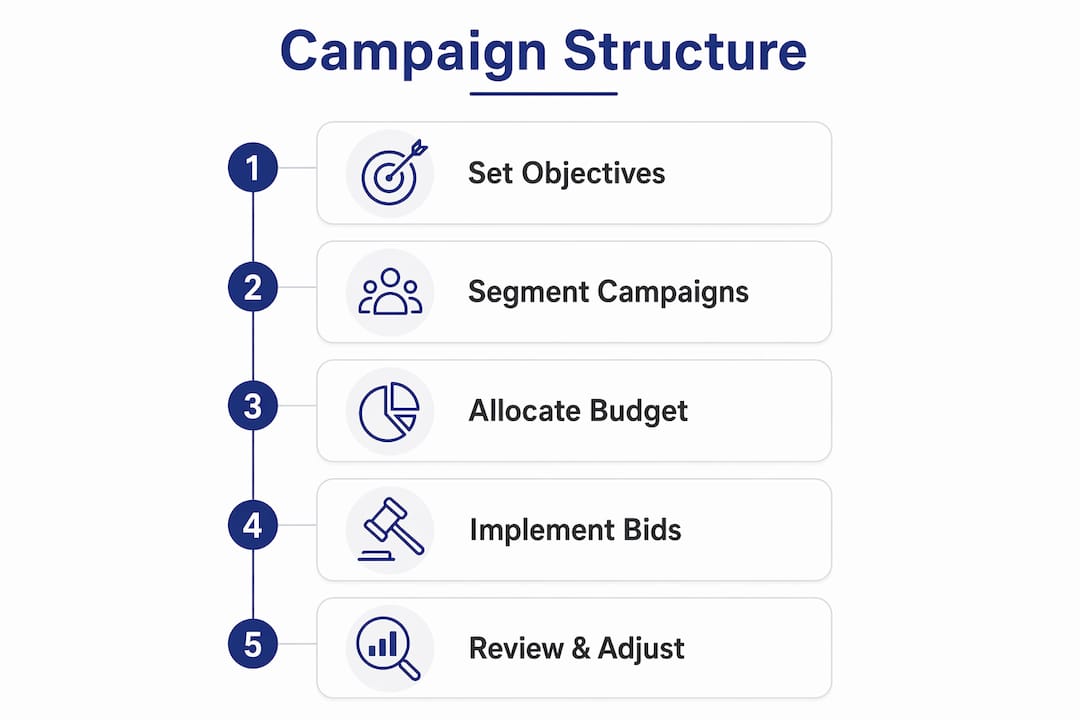
Campaign architecture is the foundation of every Amazon PPC optimization strategy. Without a clear structure, your budgets bleed across match types, and you lose visibility into what is actually driving conversions.
The most effective approach separates campaigns by intent:
-
Discovery campaigns (auto and broad match): These cast a wide net to find new converting search terms. Keep budgets modest here. The goal is data collection, not profit.
-
Conversion campaigns (phrase and exact match): These target proven, high-intent keywords. Budget should concentrate here once you have validated terms from your discovery campaigns.
-
Brand defense campaigns: These protect your brand name from competitor ads appearing on your own listings. Even a small daily budget here protects margin on your highest-converting traffic.
-
Competitor targeting campaigns: These use product targeting to appear on competitor detail pages. Treat these as awareness spend, not conversion spend, and track them separately.
Once you have this structure in place, shift budget aggressively toward exact-match campaigns on proven keywords. Exact-match campaigns deliver 30–40% lower ACoS at the keyword level compared to broad-match campaigns. That gap is significant enough to restructure your entire budget allocation around it.
Placement bid multipliers add another layer of control. Amazon lets you increase bids for top-of-search placements, product pages, and rest-of-search separately. Analyze your placement reports to find where your conversions actually come from, then apply multipliers only to placements that justify the higher cost.
Pro Tip: Never mix match types inside the same campaign. When auto, broad, and exact keywords share a budget, exact-match terms almost always get starved of spend because auto campaigns consume budget first.
What are the most effective techniques to reduce wasted ad spend?
Wasted ad spend is the single biggest profit killer in Amazon advertising. The fix is not complicated, but it requires discipline.
Negative keyword harvesting is the highest-return action you can take. Blocking non-converting search terms weekly reduces wasted spend by 15–25%. Add negatives at both the campaign and ad group level. Campaign-level negatives block terms across all ad groups. Ad group-level negatives give you surgical control when one product in a campaign attracts irrelevant traffic.
Bid setting based on unit economics is where most sellers get it wrong. Amazon’s suggested bids are based on auction data, not your profit margin. Before adjusting any bid, calculate your true break-even ACoS by accounting for cost of goods sold, Amazon fees, fulfillment costs, and returns. Setting bids without this calculation means you may appear profitable on paper while actually eroding margin with every sale.
Weekly negative keyword harvesting and bid adjustments anchored in break-even ACoS are the two highest-impact levers in any Amazon PPC optimization strategy. Apply both on a fixed weekly schedule, and your ACoS will trend down within 30 days.
Dayparting is an underused tactic. Amazon’s bulk operations allow you to schedule bid adjustments by hour and day. Pull your conversion data by time of day from your campaign reports. If your conversions cluster between 7:00 PM and 10:00 PM, raise bids during those windows and lower them during low-conversion hours. This alone can improve your return on ad spend without touching a single keyword.
Bid review cadence matters more than most sellers realize. High-performing brands review bids on a 7–14 day cycle aligned with Amazon’s attribution window. Reviewing daily creates noise-driven decisions. Amazon’s 14-day attribution means a click today may not show a conversion for two weeks. Reacting to incomplete data produces inconsistent, often counterproductive bid changes.
Pro Tip: Set a hard rule: never adjust a bid unless the keyword has at least 10 clicks in the review period. Fewer clicks means the data is statistically meaningless.
How does your product listing affect Amazon ad performance?
Your listing is the conversion engine your ads send traffic to. A weak listing wastes every dollar you spend on clicks.
The connection between listing relevance and ad impressions is direct. Listing relevance issues cause low impressions even when bids are high. Amazon’s algorithm matches ads to search queries based on listing content. If your title, bullet points, and backend keywords do not contain the terms you are bidding on, your ads will not show, regardless of bid level.
Conversion rate improvement is the fastest way to lower ACoS without touching bids. A 1-percentage-point improvement in conversion rate typically reduces ACoS by 5–8%. That means fixing your listing can deliver the same result as cutting your bids, without sacrificing ad visibility.
The four listing elements that move conversion rate most are:
-
Main image: The first image must show the product clearly against a white background and communicate scale. Blurry or misleading images kill CTR before a buyer even reads your title.
-
Title: Front-load the most important keyword and the primary product benefit within the first 80 characters. Most mobile shoppers see only the first 80 characters.
-
Bullet points: Address the top three buyer objections in the first three bullets. Use specific numbers and outcomes rather than vague claims.
-
A+ Content: Sellers with A+ Content consistently see higher conversion rates. Use comparison modules to cross-sell and lifestyle images to build purchase confidence.
Increasing bids alone cannot compensate for poor listing conversion rates. Sellers who scale spend before fixing conversion rate simply pay more for the same poor results. Audit your listing before increasing your daily budget.
| Listing element | Primary impact on ad performance |
|---|---|
| Main image | Drives CTR from search results |
| Title with target keywords | Improves ad relevance and impression share |
| Bullet points addressing objections | Increases conversion rate |
| A+ Content with comparison modules | Raises conversion rate and average order value |
| Backend keywords | Expands keyword match coverage for ads |
What role does AI play in modern Amazon PPC management?
AI tools have moved from novelty to necessity in Amazon PPC management. The volume of data across campaigns, keywords, placements, and time periods exceeds what any seller can process manually at scale.
Amazon’s Ads Agent is the clearest example of what AI brings to campaign management. Advertisers using Ads Agent reported 18% lower CPM and 16% lower CPA, with 65% of beta users seeing delivery improvements. Those are not marginal gains. They represent the kind of efficiency that compounds over months of consistent application.
The tasks AI handles best in Amazon advertising include:
-
Automated bid pacing: AI adjusts bids in real time based on budget consumption rates and conversion probability, preventing overspend early in the day.
-
Budget reallocation: AI shifts budget toward campaigns showing strong conversion signals without waiting for a weekly manual review.
-
Audience targeting refinement: AI identifies which customer segments convert at the highest rate and adjusts targeting parameters accordingly.
-
Anomaly detection: AI flags sudden drops in impressions, CTR spikes, or ACoS outliers before they become expensive problems.
Selloop applies this same AI-driven approach by analyzing your full campaign portfolio, pinpointing the areas that need attention, and tracking the impact of every change over a 21-day window. That tracking period matters because it aligns with Amazon’s attribution cycle and gives you clean before-and-after data without the noise of daily fluctuations.
The right way to use AI is as a force multiplier for your own judgment. AI surfaces the data and flags the opportunities. You make the final call on strategy, budget priorities, and listing changes.
Key Takeaways
Amazon ad optimization delivers the highest returns when sellers combine disciplined weekly workflows with bid decisions grounded in unit economics, not Amazon’s suggested bids.
| Point | Details |
|---|---|
| TACoS over ACoS | Track TACoS as your primary metric to measure true business growth, not just ad efficiency. |
| Structure by intent | Separate discovery, conversion, and brand defense campaigns to control spend and data clarity. |
| Harvest negatives weekly | Block non-converting search terms every week to cut wasted spend by 15–25%. |
| Fix listings before scaling spend | A 1-point conversion rate gain reduces ACoS by 5–8%, making listing work the highest-leverage fix. |
| Use AI as a multiplier | AI tools like Selloop track 21-day change impact and surface opportunities human review misses. |
What I’ve learned from watching sellers optimize Amazon ads
The most common mistake I see is sellers treating ACoS as the only metric that matters. A seller running a new product at 30% ACoS may be doing exactly the right thing if TACoS sits at 15–20% and organic rank is climbing. Cutting bids to chase a lower ACoS in that scenario actively hurts long-term profitability.
The second mistake is daily reactivity. A weekly 60-minute review every Monday covering KPIs, bids, budgets, placements, and listing conversion rate produces better results than daily micro-adjustments. Daily data is noisy. Weekly data shows trends. Trends are what you act on.
The third mistake is the most expensive: scaling ad spend before the listing is ready. I have watched sellers pour thousands of dollars into campaigns driving traffic to listings with a 5% conversion rate. The math never works. Fix the listing first, then scale the budget.
AI tools change the game not by replacing seller judgment but by making that judgment faster and more accurate. The sellers who will win in 2026 are those who combine a disciplined weekly workflow with AI-powered analysis that catches what manual review misses.
— Luis Luengo / Selloop.ai Founder
How Selloop fits into your Amazon PPC workflow
Running profitable Amazon ads requires consistent analysis, fast bid adjustments, and clear tracking of what is working. Most sellers lack the time to do all three well.
Selloop is built for exactly this problem. The platform analyzes your full campaign portfolio with AI, identifies where spend is being wasted, and justifies every recommendation with clear data. Every change you make gets tracked over a 21-day window so you can see the real impact without building custom spreadsheets. Whether you manage five campaigns or fifty, Selloop gives you the visibility to act confidently. See how it works and review Selloop’s pricing to find the right plan for your catalog size.
FAQ
What is Amazon ad optimization?
Amazon ad optimization is the process of systematically refining PPC campaigns to lower ACoS, reduce wasted spend, and increase return on ad investment through keyword management, bid adjustments, and listing improvements.
What is a good TACoS for Amazon ads?
Mature products should target a TACoS of 8–12%. Growth-phase products may run 15–20%, but anything above 25% on a mature ASIN signals a structural problem in the campaign or listing.
How often should I review my Amazon PPC bids?
Review bids every 7–14 days to align with Amazon’s attribution window. Daily bid changes react to incomplete data and produce inconsistent results.
How do negative keywords reduce wasted ad spend?
Negative keywords block your ads from appearing on irrelevant search queries. Adding negatives weekly based on your Search Term Report cuts wasted spend by 15–25% and concentrates budget on terms that convert.
Does improving my listing actually lower ACoS?
Yes. A 1-percentage-point improvement in conversion rate reduces ACoS by 5–8% by generating more sales from the same traffic volume. Listing optimization is often more effective than bid cuts.