How to Increase Amazon Profit Margin With AI PPC
Protect and grow your Amazon net margin by prioritizing SKU-level contribution margin, cutting PPC waste with AI-driven bidding and negative-keyword automation, and shifting repeat revenue to Subscribe & Save. Three levers move the needle fastest: pause loss-making SKUs, apply AI-driven negative keyword harvesting and bid rules, and test a 5–10% price lift on top SKUs while protecting margin floors. Start today by running a SKU contribution-margin audit and flagging any SKU below 15% contribution margin for corrective action.
- Pause loss-making SKUs — SKUs with high volume and a contribution margin below 15% are a liability, not an asset
- Apply AI-driven negative keyword harvesting via Amazon Advertising (Amazon PPC) to stop bleeding budget on non-converting search terms
- Test a 5–10% price lift on top SKUs; McKinsey analysis shows a 1% price increase lifts operating profit by roughly 11.1%
FBA fees and ad spend are your two largest variable costs. Selloop’s 21-day change-tracking window lets you confirm whether any bid or keyword change actually moved contribution margin before you scale it.
Pro Tip: Export your SKU economics from Seller Central today. Any SKU with a notably low contribution margin after COGS, referral fee, FBA fee, inbound shipping, and ad spend is a candidate for discontinuation or repricing — not more ad spend.
Table of Contents
- How to increase Amazon profit margin: the highest-impact levers
- What PPC tactics actually protect your unit contribution margin?
- How do you measure whether PPC changes actually increase profit?
- Non-PPC levers that move margin faster than more ad spend
- What does a 30/60/90-day rollout actually look like?
- How Selloop validates margin improvements in 21 days
- Key Takeaways
- An operator’s perspective on protecting margin at scale
- Selloop puts these tactics on autopilot
- Useful sources for deeper reading
How to increase Amazon profit margin: the highest-impact levers
Ranked by speed of margin impact:
- [High] Kill or reprice low-margin SKUs — contribution margin below 15% after all fees signals a structural problem ads cannot fix. Discontinue or renegotiate landed cost first.
- [High] AI PPC automation — manual PPC management fails at scale; automated bidding keyed to contribution margin, not ACoS alone, prevents wasted spend in real time.
- [High] Negative-keyword harvesting — automated negation of non-converting search terms is the fastest recurring lever to cut customer acquisition cost.
- [Medium] Listing conversion-rate optimization (CRO) — A+ Content, Amazon Vine reviews, and optimized titles lift conversion without increasing ad spend; Amazon’s own data shows A+ Content raises sales by an average of 5.6%.
- [Medium] Packaging and fulfillment audit — small dimensional changes can move SKUs to cheaper FBA tiers; recent per-unit fee increases make this audit mandatory.
- [Medium] Subscribe & Save enrollment — prioritizing high-margin SKUs in Subscribe & Save locks in repeat revenue and lowers future customer acquisition cost.
- [Low] Supplier negotiation — renegotiate terms after 21-day data proves volume; use margin data as leverage.
- [Low] Retention flows — email and SMS sequences reduce CAC over time but take 60–90 days to show measurable impact.
Pro Tip: Use a conservative AI optimization profile on new or thin-data SKUs. Switch to balanced or aggressive only after 21-day validation confirms persistent contribution-margin improvement. Category volatility matters: a seasonal SKU with erratic demand needs tighter guardrails than an evergreen product.
What PPC tactics actually protect your unit contribution margin?
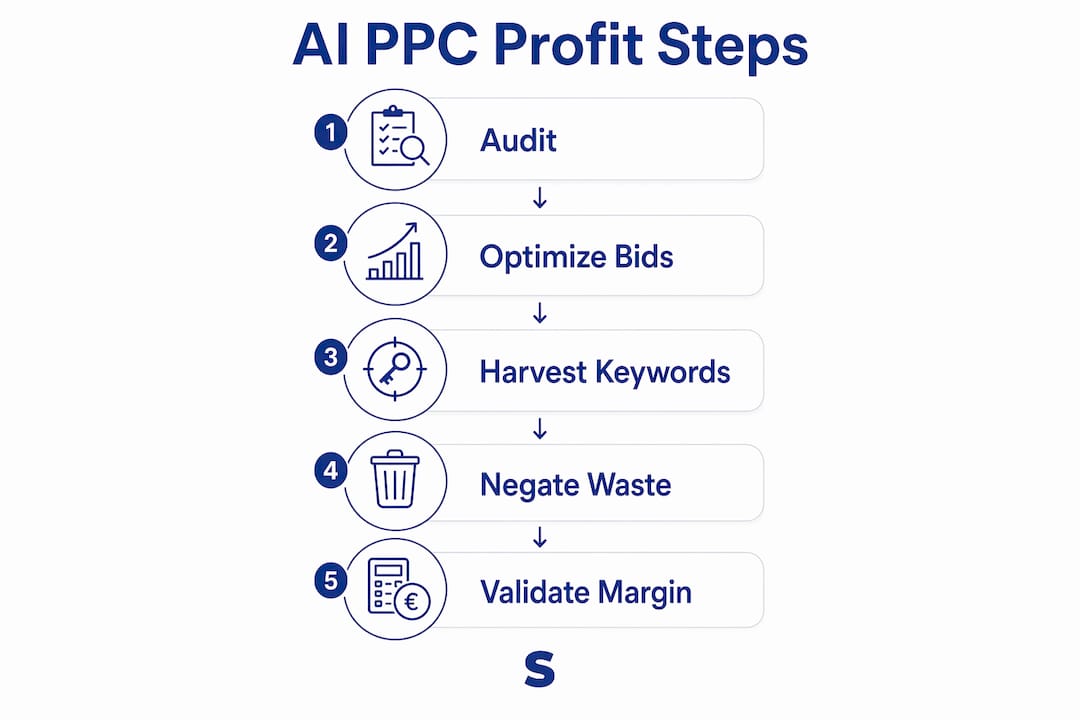
The declarative answer: use AI-driven bidding that optimizes toward unit contribution margin or return on marketing investment (ROMI), not ACoS or ROAS alone. ACoS tells you the ratio of ad spend to revenue; it says nothing about whether you made money after fees.
Four core tactics:
- Margin-aware automated bidding — set bid rules that reference your contribution margin floor, not a revenue target. If a keyword’s adjusted ACoS (ad spend ÷ gross profit after fees) exceeds your margin floor, the bid drops automatically.
- Negative search-term harvesting — automated negative keyword generation removes search terms that generate clicks but no profitable conversions. Run this weekly, not monthly.
- Keyword-level budget reallocation — shift budget from broad-match discovery campaigns to exact-match terms that already convert at or below your adjusted ACoS target.
- SKU-targeted campaign segmentation — separate high-margin SKUs into their own campaigns so budget never bleeds from a profitable product to subsidize a weak one.
For agencies managing multiple accounts, the sequencing matters: connect data → run a campaign health audit → apply conservative AI rules → validate 21-day results → scale winners. Monitor conversion rate, ACoS, adjusted ACoS, and SKU contribution margin throughout.
Pro Tip: Use search-term-level harvests for two jobs simultaneously: seed new exact-match bids from terms that convert profitably, and populate negative lists to block the same terms in broad-match campaigns where they waste budget.

How do you measure whether PPC changes actually increase profit?
Measure impact via SKU-level contribution margin and adjusted ACoS. Evaluating ad spend by its effect on unit contribution margin, rather than top-line ad revenue, is what separates high-growth retailers from volume-chasing ones.
Key formulas:
- Contribution margin per unit = Revenue − COGS − Referral fee − FBA fee − Inbound shipping − Returns cost − Ad spend
- Adjusted ACoS = Ad spend ÷ Gross profit after fees (target: below your contribution margin %)
- ROMI = (Revenue from ads − Total ad cost) ÷ Total ad cost
- LTV:CAC = Customer lifetime value ÷ Customer acquisition cost (target: 3:1 or higher)
SKU tracking template:
| SKU | Revenue | COGS | Referral Fee | FBA Fee | Inbound Ship | Returns | Ad Spend | Contribution Margin | Adj. ACoS | Before 21-Day evaluation | After 21-Day evaluation |
|---|---|---|---|---|---|---|---|---|---|---|---|
| SKU-002 | $50 | $15 | — | — | — | — | — | — | — | — | — |
| SKU-002 | $30 | — | — | — | — | — | — | — | 152% | — | — |
SKU-002 above is a discontinuation candidate. Its adjusted ACoS of 152% means every ad dollar spent on it destroys margin. A contribution margin below 15% is a discontinuation trigger.
Use a 21-day observation window for each change. Competitive Page 1 sellers spend an average of ~15% of revenue on PPC in many categories; an unchecked ACoS above 30% on established SKUs almost certainly burns margin. For statistical confidence, aim for at least 50 conversions per variant before drawing conclusions, and extend the window to 28 days in low-volume categories.
Non-PPC levers that move margin faster than more ad spend
Non-PPC levers often deliver larger, more permanent margin gains than incremental PPC tweaks. Price, SKU rationalization, packaging, subscription models, and supplier terms all compound over time.
- Price testing — a 5–10% price increase on top SKUs is the single fastest lever. The McKinsey 11.1% operating-profit lift from a 1% price increase applies here; test in 5% increments and monitor conversion rate and ROMI over 21 days before committing.
- FBA packaging audit — FBA fulfillment fees are highly sensitive to package dimensions; shaving a centimeter off a box can move a SKU to a cheaper size tier. Run this audit every time Amazon updates its fee schedule.
- Subscribe & Save enrollment — shifts the business model from one-off transactions to compounding monthly revenue, reduces CAC, and signals repeat-purchase behavior to the A10 algorithm for better organic visibility.
- Bundle strategy — bundle slow-moving, high-margin items with bestsellers to clear overstock without blanket discounting. Apply higher discounts to slow-sellers with high margins; give top sellers little or no discount.
- Storage fee management — excess inventory triggers long-term storage fees. Set reorder points based on 60-day sell-through, not gut feel, and use AI pricing tools to liquidate aging stock before fee thresholds hit.
- Supplier negotiation — bring 21-day volume data to renegotiate terms. A 5% reduction in COGS on a $20 product with a 20% margin is equivalent to a 25% margin improvement.
What does a 30/60/90-day rollout actually look like?
Start with an immediate audit, apply conservative AI rules and price tests, then scale winners after 21-day validation.
| Phase | Milestone | KPI Target | Decision Gate |
|---|---|---|---|
| Day 1–30 | SKU contribution audit; flag SKUs with contribution margin below 15%; connect PPC data to Selloop | Identify top 20% margin SKUs; baseline adjusted ACoS | Pause any SKU with adj. ACoS >100% |
| Day 31–60 | Deploy conservative AI bid rules; launch 5% price tests on top SKUs; enroll in Subscribe & Save | Adjusted ACoS drops 10–15%; contribution margin stable or rising | Scale bid rules if 21-day data confirms margin improvement |
| Day 61–90 | Packaging audit; supplier renegotiation; retention flow setup; escalate to balanced AI profile | Contribution margin up on hero SKUs; CAC trending down | Roll back any change where contribution margin did not improve after 21 days |
- Days 1–30: Audit first, change nothing until you have baseline data. Flag SKUs, map FBA tiers, and set your contribution margin floor.
- Days 31–60: Conservative changes only. One variable at a time. Validate with 21-day windows.
- Days 61–90: Scale what worked. Renegotiate with suppliers using real margin data. Build retention infrastructure.
How Selloop validates margin improvements in 21 days
Selloop applies margin-aware AI rules, executes changes with one-click approval, and tracks the outcome over 21 days to confirm true contribution-margin impact, not just ACoS movement.
What Selloop automates:
- Automated negative-keyword harvesting and negation (maps directly to the negative-term tactic above)
- Margin-aware bidding profiles: conservative, balanced, and aggressive, selectable per SKU or campaign
- Campaign health scoring to surface which campaigns need attention first
- One-click change approval so sellers review recommendations before anything goes live
- 21-day result tracking with before/after contribution margin comparison, no spreadsheet required
Selloop was built by Luis Luengo, an Amazon seller with 10+ years of experience across European marketplaces. The platform reflects what an experienced operator actually needs: clear data justification for every recommendation, not a black box.
For sellers evaluating PPC optimization software, the 21-day validation window is what separates genuine margin improvement from a temporary ACoS dip that reverses the following month.
Key Takeaways
SKU-level contribution margin is the only metric that tells you whether your Amazon business is actually profitable after every fee and ad dollar is accounted for.
| Point | Details |
|---|---|
| Run a SKU contribution audit | Flag every SKU with a contribution margin below 15% after COGS, fees, and ad spend for repricing or discontinuation. |
| Use margin-aware AI bidding | Optimize bids toward adjusted ACoS and ROMI, not ACoS alone, to protect per-unit profit. |
| Harvest negatives weekly | Automated negative-keyword harvesting is the fastest recurring lever to cut wasted ad spend. |
| Test price before cutting ads | A 5–10% price lift on top SKUs often improves margin faster than reducing ad spend; validate over 21 days. |
| Selloop tracks every change | Selloop’s 21-day window confirms whether bid and keyword changes actually improved contribution margin before you scale. |
An operator’s perspective on protecting margin at scale
Margin protection is not a project you finish. It is a weekly operating discipline, and most sellers abandon it after the first audit because the feedback loop feels too slow. The 21-day window feels long when you want answers in 48 hours, but it is the minimum time needed to separate signal from noise in PPC data. The sellers who compound margin gains are the ones who build a rhythm: audit on Monday, review 21-day results on Wednesday, approve or roll back on Friday. Contribution margin becomes the North Star, and every team decision, from ad budget to supplier terms to packaging specs, gets filtered through it.
The cultural shift matters as much as the tactics. Incentivize your team on contribution margin per order, not revenue or units sold. A campaign that drives volume at a 5% contribution margin is not a win; it is a slow drain. Subscribe & Save and retention flows are underinvested precisely because they do not show up in weekly sales dashboards the way a PPC spike does. Build the measurement infrastructure first, then the discipline follows.
Selloop’s AI-driven PPC management operationalizes this rhythm for sellers who cannot afford to spend hours in Seller Central every week.
Selloop puts these tactics on autopilot
Wasted ad spend is the fastest way to destroy Amazon margin, and it compounds silently across dozens of campaigns. Selloop gives sellers and agencies a single platform to find where budget is bleeding, apply margin-aware AI bid rules, and confirm the fix worked, all within a 21-day window that removes the guesswork from PPC optimization.
Plans start at €29/month with a 7-day free trial. No agency fees, no complex setup, no spreadsheets. You approve every change before it goes live, and Selloop tracks the result so you know exactly what moved your margin. If you manage multiple Amazon accounts, the agency tier scales without adding headcount.
Start your free trial at Selloop.ai and run your first campaign health audit today.
Useful sources for deeper reading
The research and references behind this guide, in recommended reading order:
- Trellis — Your 2026 Guide to Amazon Profit Margins — supports the case for AI-driven PPC automation and the ~15% revenue PPC spend benchmark; read first for the macro margin context.
- SentryKit — Amazon Profit Margin Guide 2026 — covers SKU contribution margin formulas, FBA fee sensitivity to packaging dimensions, and the 21-day operational rhythm; essential for the measurement section.
- WebMedic — Ecommerce Profit Margin Benchmarks 2026 — source for the McKinsey 1% price-lift stat and the Subscribe & Save / SKU prioritization recommendations.
- Eulav — How to Scale Ecommerce Profit — practitioners’ framework for SKU-level contribution margin thresholds (flag below 30%, discontinue below 15%).
- SPXCommerce — eCommerce Profitability at Scale — covers AI dynamic pricing, inventory-aware repricing, and operational automation for margin protection.
- Amazon Seller Central — How to Boost Amazon Listings — primary source for A+ Content’s 5.6% average sales lift and Sponsored Products campaign mechanics.
- SocialFuel — Ads insights that move the needle in 2026 — real-time analytics and ad-insight methods relevant to the measurement and AI analytics sections.