Search term isolation means giving every proven shopper query its own home in an exact-match campaign, then blocking that same query everywhere else with negatives. Do it right and you get clean attribution, bids that actually match performance, lower blended ACoS, and an account you can scale without guessing. Start by pulling your search term report and flagging any query showing up in more than one campaign.
TL;DR:
- Search term isolation requires creating dedicated exact-match campaigns for high-performing queries and blocking duplicate traffic with negatives to prevent cannibalization.
- Implementing a three-tier hierarchy—discovery, research, and performance—helps surface new queries, test promising terms, and maximize profit from proven winners.
- Regular weekly harvesting and negative keyword management are essential for maintaining accurate attribution and effective bid control.
- Avoid over-isolating by promoting only sustained performers and removing old or underperforming terms to prevent account bloat and loss of flexibility.
Table of Contents
- What Search Term Isolation Actually Means
- Building the Three-Layer Isolation Architecture
- How to Harvest Search Terms Without Duplicating Spend
- Getting Negative Keyword Architecture Right
- Setting Thresholds That Actually Reflect Unit Economics
- Avoiding Over-Isolation and Keeping Your Account Clean
- Running Isolation as a Weekly Bulk-File Routine
- Why Isolation Is a Capability, Not a Cleanup Project
- How Selloop Supports the Isolation Workload
- Sources
What Search Term Isolation Actually Means
A “keyword” is what you bid on. A “search term” is what a shopper actually typed. Amazon’s match types blur the line between them constantly, because one keyword bucket often gets impressions from dozens of different real queries, each with wildly different conversion rates lumped into a single average CPC.

Search term isolation fixes that by giving one high-performing search term ownership of a single exact-match campaign, then walling it off from every broader campaign that could still trigger it. Without isolation, your auto campaign, your broad match, your phrase match, and your exact match can all fire on the exact same query simultaneously. You’re not testing four strategies, you’re bidding against yourself four times over.
This is why keyword cannibalization amazon sellers complain about isn’t really a keyword problem at all. It’s a structural one. Once a term proves itself, isolation flips control from an aggregated bucket average to a bid decision made on that specific query’s actual numbers.
The practical shift looks like this:
- Auto and broad campaigns exist to surface unknown queries, not to compete with your winners.
- Every promoted term should carry its own bid, informed by its own conversion rate and ACoS, not a blended average.
- Negatives are the mechanism that enforces “one query, one owner” across your whole account.
That last point is the one sellers skip, and it’s the one that makes the whole system work.
Building the Three-Layer Isolation Architecture
Isolation works as a hierarchy, not a single campaign tweak. Most experienced advertisers run three tiers, each with a distinct job and its own budget logic, described well in Adverio’s breakdown of the model.
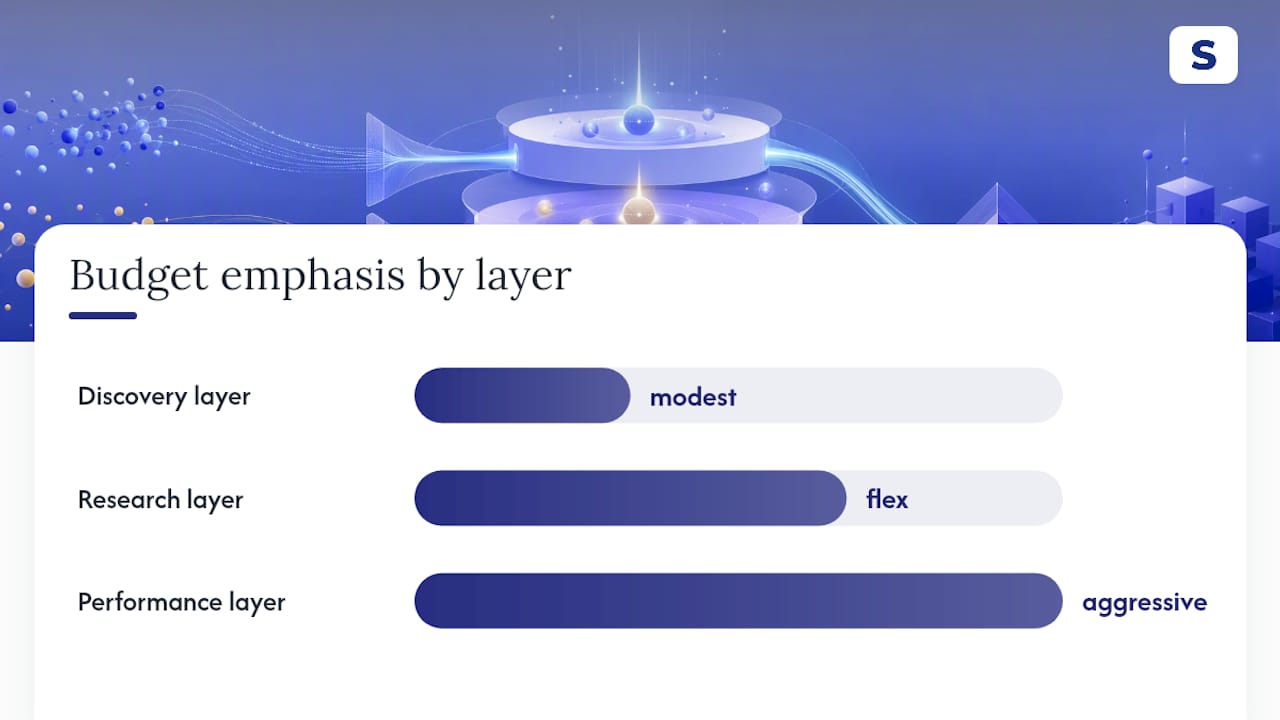
Discovery layer (auto campaigns). This tier exists purely to surface search terms you haven’t targeted yet. Keep the budget modest and bids controlled. Its job isn’t to convert efficiently. It’s to generate data.
Research layer (broad and phrase match). This is where you refine. Terms that showed early promise in discovery get tested here with slightly tighter targeting before they earn a permanent home. Budget should flex based on what’s actively being tested.
Performance layer (exact match). These are proven winners with dedicated bids. Budget here should be aggressive enough to defend rank, because this is where profit actually gets made.
Negatives enforce the walls between these tiers. Place negative exact matches at the campcampaign level when a term graduates from discovery or research into performance, and use ad-group-level negatives when you need finer control within a single campaign that runs multiple ad groups.
Account structure typically follows one of two shapes:
- Per-ASIN hierarchy: each product gets its own discovery, research, and performance campaigns, useful when products serve different customer intents.
- Per-brand hierarchy: campaigns are grouped by brand or category, useful for sellers with many similar SKUs that share the same shopper language.
Naming conventions matter more than sellers admit. A structure like ASIN_Discovery_Auto, ASIN_Research_Broad, ASIN_Performance_Exact keeps a growing account navigable instead of a maze six months in.
How to Harvest Search Terms Without Duplicating Spend
Harvesting is the operational engine behind isolation. Skip the process and you’re back to guessing which terms deserve their own campaign.
- Export your search term report weekly and group results by customer search term rather than by campaign, which is how you actually spot the same query performing across multiple campaigns at once.
- Apply promotion criteria. A term needs sustained conversions, not a lucky day, plus enough click velocity to be statistically meaningful, plus an ACoS that clears your breakeven number given your margin and average order value.
- Add the term as an exact-match keyword in a dedicated performance campaign, with a bid informed by its individual conversion data rather than the average CPC it was riding in the discovery tier.
- Add a negative exact for that same term in every campaign it came from, whether that’s auto, broad, or phrase. This step is the one sellers forget, and skipping it is the single biggest cause of keyword isolation amazon failures where sellers think they’ve isolated a term but are still paying for it twice.
- Check results at day 8 and day 15 before treating the promotion as permanent.
This weekly cadence is what separates search term isolation from a one-time cleanup project. It’s a routine, and a consistent harvesting habit compounds every week you run it.
Getting Negative Keyword Architecture Right
Negatives are what actually enforce isolation. Get the match type wrong here and you’ll either keep bleeding duplicate spend or accidentally choke off the discovery data you need to find your next winner.
- Use negative exact in your auto and research tiers the moment you promote a specific query. This blocks that exact phrase without touching anything else those campaigns might still discover.
- Use negative phrase only when you genuinely need to block an entire family of related searches, not just one query. Over-apply phrase negatives and you’ll accidentally wall off variations you never meant to touch, which quietly shrinks your discovery funnel.
- Apply negatives at the campaign level when the goal is to protect one campaign’s data from a specific term. Use ad-group-level negatives when multiple ad groups share a campaign but need different exclusion rules.
- If you clone campaigns for new products, audit the negative lists in the clone immediately. Inherited negatives from the original campaign can silently block terms that would have performed differently for the new listing.
Pro Tip: Applying the negative the same day you promote a term, not a week later, is what converts discovery spend into a single owner’s spend. Delay it, and you’re paying for the same click twice while you wait.
One warning worth repeating: don’t flip on strict isolation in the first days of a brand-new campaign. Perpetua’s guidance on this is blunt: isolating too early starves your discovery layer of the data it needs to identify real winners, and you end up promoting noise instead of signal.
Setting Thresholds That Actually Reflect Unit Economics
Fixed rules like “promote after five conversions” fail because five conversions on a $12 average order value means something completely different than five conversions on a $65 one. A flat click count or conversion count ignores the only thing that matters, which is whether the term is profitable at scale.
Senior PPC operators increasingly use velocity models instead of static cutoffs, tracking how fast a term accumulates conversions relative to your account’s baseline and treating that acceleration, not a raw count, as the signal worth acting on.
Building a threshold from your own numbers isn’t complicated:
- Calculate your breakeven ACoS using margin and average order value: if margin is 30% and you’re comfortable spending half of it on advertising, your breakeven ACoS sits near 15%.
- Require a term to clear that number with enough order volume to trust the pattern, not a single lucky week.
- Set different ACoS targets by intent layer. Brand-adjacent terms can usually run tighter margins than category-generic ones, and competitor terms often justify a higher ACoS because of their strategic value in the funnel, a point worth pairing with how you structure bids around performance data rather than a blanket target.
Avoiding Over-Isolation and Keeping Your Account Clean
The most common failure mode isn’t under-isolating, it’s the opposite. Sellers get excited about the tactic and start spinning up an exact campaign for every term that converts twice, and within a few months the account is bloated with dozens of low-volume campaigns nobody can manage.
- Only promote terms with sustained performance across multiple weeks, not a single good day.
- If automation flags a candidate, route it through human approval before it goes live. Guardrails matter because auto-applied harvests can’t tell a genuine winner from a seasonal spike.
- Reverse isolation when a promoted term’s volume dries up or its ACoS drifts past your threshold after your evaluation window closes. Remove the blocking negatives and let it flow back into discovery.
Pro Tip: Run a weekly search-term overlap check as a five-minute habit, not a monthly fire drill. Catching a duplicated query in week one is a bid tweak; catching it in month three is a structural rebuild.
Pair that weekly habit with a monthly structural review of your whole account, checking naming conventions, orphaned negatives, and campaigns that have quietly stopped earning their budget.
Running Isolation as a Weekly Bulk-File Routine
At scale, doing this by hand in the campaign manager doesn’t work. The sellers who make isolation stick treat it as a bulk-file operation with a human checkpoint built in.
- Export search term reports across all active campaigns.
- Flag candidates that clear your velocity and breakeven ACoS thresholds.
- Generate a bulk file with two row types: exact-match keyword additions for the performance campaign, and negative exact additions for every source campaign the term is leaving.
- Route the file through human review before upload, checking for seasonal anomalies or one-off spikes that shouldn’t be locked in.
- Upload, then check the isolated term’s results at day 8 and day 15 before calling the promotion permanent.
Your bulk file typically needs a handful of standard columns: campaign name, ad group name, keyword or product targeting, match type, bid, and status. Build a template once, and the weekly export becomes closer to fifteen minutes than an afternoon project.
It’s long enough to smooth out day-to-day noise but short enough that you’re not carrying a bad bid decision for months, and it’s the same principle behind reclaiming wasted spend without guessing whether a change actually worked.
Why Isolation Is a Capability, Not a Cleanup Project
Most sellers treat isolation like a one-time account audit. Run it once, feel better, move on. That undersells what it actually builds: a growing library of proven, invested search-term assets, each with its own performance history you can point to and defend.
That library is worth more than the ad spend it saves. When you can show a stakeholder or a client exactly which terms were harvested, why they were promoted, and what happened to ACoS over the following weeks, you’re no longer arguing opinions about PPC. You’re showing a track record.
The automation question comes down to trust in the data, not laziness. Automate the detection and the bulk-file generation. Keep a human in the approval loop until a category has enough history that false positives become rare. Isolation done well isn’t a fix you apply once. It’s an operating rhythm, and rhythms are what separate accounts that scale cleanly from accounts that need a rebuild every year.
— Selloop
How Selloop Supports the Isolation Workload
Selloop is built for exactly the routine this article just walked through, minus the manual bulk-file work. It syncs and analyzes your Sponsored Products campaigns and proposes exact-match additions and negative exact search terms, which you apply with one click instead of exporting reports by hand every Monday.
Every recommendation comes with the data behind it, so you approve a change with full context instead of guessing whether the AI got it right. Start your free trial at Selloop and run your first overlap audit this week.