Use expansion to find new keywords and ASINs; switch to isolation the moment a term proves itself. The rule of thumb: launch phase means expand, growth phase means harvest and promote, mature phase means isolate and defend. Watch TACoS paired with conversion rate by placement, not ACOS alone, since it reflects both ad efficiency and organic lift.
The quick trigger for promotion:
- A search term hits 3+ orders or 10+ clicks with no sale.
- You move it into its own exact-match campaign immediately.
- You negate it from the discovery campaign the same day, before the next dayparting cycle starts.
Key Takeaways
Isolation controls bids and attribution for proven winners, while expansion finds the next winner, and the two must run in parallel on a fixed weekly and bi-weekly cadence to protect margin.
| Point | Details |
|---|---|
| Match tactic to lifecycle | Expand at launch, harvest during growth, isolate once an ASIN or keyword matures. |
| Use velocity thresholds | Promote terms only after 3+ orders or 10+ clicks to avoid isolating on noise. |
| Negate the same day | Always cut a promoted term from its source campaign immediately to stop internal bid competition. |
| Track TACoS, not just ACOS | TACoS captures organic lift and gives a clearer read on true profitability. |
| Verify before you scale | Selloop's day 8 and day 15 verdicts confirm whether a promotion or bid change actually held up before you roll it out further. |
Table of Contents
- Isolation vs Expansion Amazon: What Search Term Isolation Actually Means
- What Expansion Looks Like in a Discovery Campaign
- When Should You Isolate a Keyword Instead of Expanding It?
- The 90-Day Blend: Expansion Into Isolation, Step by Step
- Common Mistakes That Wreck an Isolation Strategy
- Bulk Workflows, Automation, and Verifying What Actually Worked
- Weekly, Bi-Weekly, Monthly, and Quarterly Checklist
- Why Structure Beats Spend
- Turn This Playbook Into a Repeatable System
- Frequently Asked Questions
- Sources
Isolation vs Expansion Amazon: What Search Term Isolation Actually Means
Isolation means pulling a proven search term or ASIN out of a broad discovery campaign and giving it its own exact-match campaign or ad group. You do this to control the bid on that single term without dragging along the noise of fifty other queries competing for the same budget. It also cleans up attribution: you know exactly what that keyword costs and returns, instead of guessing from blended campaign data.
The sequence practitioners follow:
- Harvest the search term report and flag anything hitting velocity thresholds, generally 3+ orders or 10+ clicks with zero conversions (the latter tells you to cut it, not promote it).
- Promote the winner into a dedicated exact-match campaign with a bid you control independently.
- Negate that exact term from the source campaign (auto or broad) the same day you promote it, so you stop paying twice for the same click.
Skipping step three is the single most common cause of internal auction inflation, where your own campaigns bid against each other for the same buyer.
Pro Tip: Don’t isolate on gut feeling. A single order at a $45 price point looks like a win but could be a fluke return customer. Wait for the second or third order before you commit a dedicated campaign to it.

Isolation isn’t free. Every isolated campaign is another line item to monitor, another bid to adjust, another spot where a negative list has to grow. For a catalog of five ASINs that’s manageable. For two hundred SKUs, over-isolating turns into a full-time job that eats the margin gains it was supposed to protect.
What Expansion Looks Like in a Discovery Campaign
Expansion is the deliberate search for new keywords and ASINs before you know which ones will work. It runs through two main instruments: auto campaigns with capped budgets that let Amazon’s algorithm surface related search terms, and broad-match or manual campaigns seeded with your own keyword research to widen the net further.
Keep discovery bids conservative, generally in the $0.40 to $0.70 range depending on category competitiveness, with a hard daily cap per ASIN so a runaway auto campaign can’t burn next week’s budget in a weekend. The goal at this stage isn’t profit. It’s data.
- Long-tail, conversational queries surfaced through expansion often convert better than shorter head terms in many categories, though the actual lift varies widely depending on your niche.
- These queries almost never show up in manual keyword research because they sound like something a person types while half distracted, not a marketer’s keyword list.
- Run discovery for at least two to three weeks before evaluating harvest candidates. Anything shorter and you’re judging noise, not signal.
Expansion campaigns should stay open indefinitely at a small budget, even after you’ve promoted your best performers out of them. New buyer language shows up constantly.
When Should You Isolate a Keyword Instead of Expanding It?
The decision isn’t philosophical. It’s arithmetic tied to lifecycle stage. A brand-new ASIN in its first two weeks has no business running isolated exact-match campaigns because there’s no data to isolate around yet. A three-year-old bestseller with a stable conversion rate has no business still living inside a broad discovery campaign.
Match the tactic to the stage:
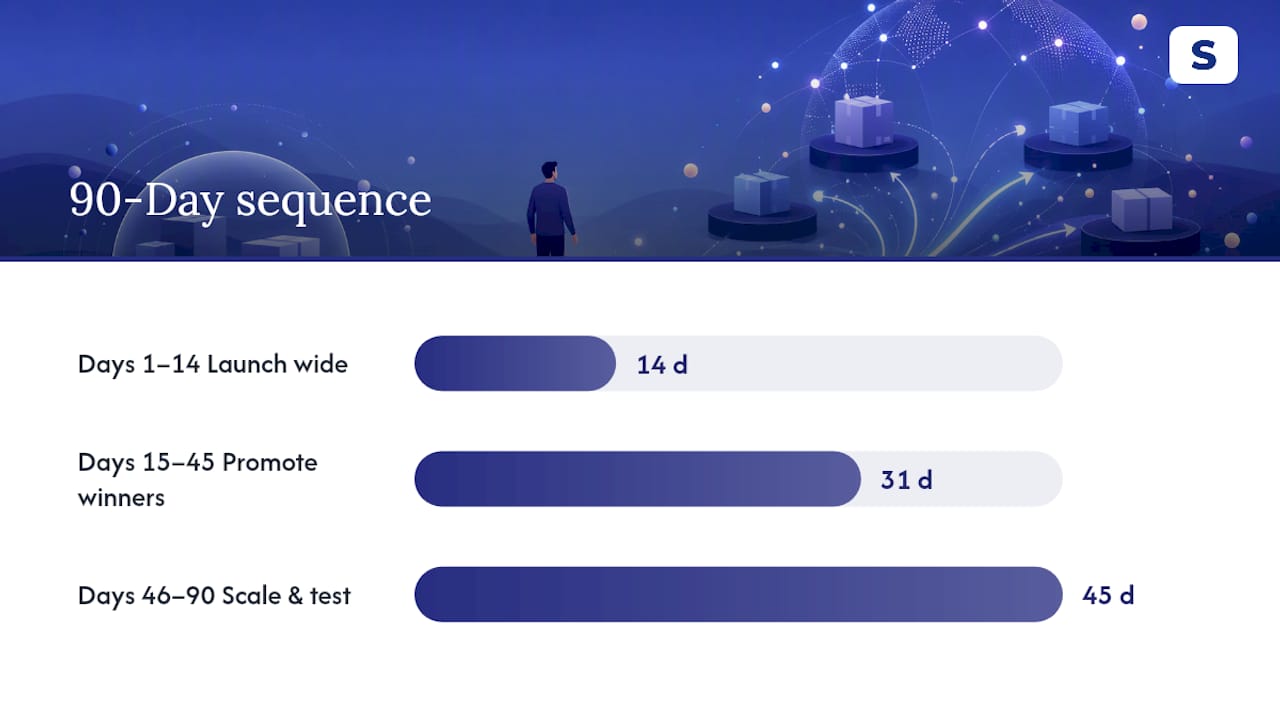
- Launch (days 1 to 14): expand only. Loose targeting, wide auto campaigns, elevated bids to build rank velocity.
- Growth (days 15 to 45): harvest weekly, promote anything crossing the velocity threshold, negate immediately.
- Mature (day 46 onward): isolate aggressively, tighten bids, defend market share with product-targeting campaigns against competitor ASINs.
A keyword with 12 clicks, 3 orders, and a 25% conversion rate at a TACoS under your break-even line is a clear isolation candidate. The same term at 8% conversion isn’t, no matter how many clicks it’s racked up.
Business context matters as much as the numbers. A SKU with thin margin can’t absorb the maintenance overhead of a fully isolated structure, and TACoS is generally the better decision metric here than ACOS, since it captures organic lift that isolation-heavy accounts tend to undervalue. If your catalog runs 300 SKUs and you’re managing PPC solo, isolating every qualifying term will bury you before it pays off.
The 90-Day Blend: Expansion Into Isolation, Step by Step
A tiered funnel, running discovery, exact-match, and product-targeting layers in parallel, is the structure most sellers converge on by the time an ASIN matures. Here’s how to sequence the transition without guessing.
- Days 1 to 14: Launch wide. Run auto campaigns with capped daily budgets and elevated bids purely for rank velocity, not profit. Loose ACOS targets are expected here; you’re buying visibility and data, not margin.
- Days 15 to 45: Pull the search term report weekly. Any term meeting the velocity threshold, 3+ orders or 10+ clicks, gets promoted into its own exact-match campaign and negated from the source campaign that same day. This is the window where most of your isolation decisions get made.
- Days 46 to 90: Scale the exact-match winners. Apply placement bid modifiers based on your top-of-search conversion rate divided by your rest-of-search conversion rate, adjusting bids proportionally rather than by a flat percentage guess. Start basic dayparting tests if your category shows clear hour-of-day patterns. Watch TACoS tighten week over week as the isolated campaigns take over spend from discovery.
- Post-90: Settle into a maintenance cadence: weekly harvest and negation, bid adjustments every two weeks on keywords with at least 10 clicks of fresh data, and a full placement audit once a month.
Pro Tip: When you calculate placement modifiers, don’t apply the same multiplier across every ASIN. A $60 impulse buy and a $600 considered purchase have wildly different top-of-search conversion lift, and one modifier formula will overcorrect for one of them.
The bid strategy math behind placement modifiers gets more forgiving once you have 90 days of clean, isolated data to work from instead of blended auto-campaign averages.
Common Mistakes That Wreck an Isolation Strategy
Most broken accounts share the same handful of problems, and they’re easy to spot once you know where to look.
- Keyword cannibalization: run a match-type overlap audit by pulling your search term report and checking whether the same query is triggering impressions in both your auto campaign and an exact-match campaign. If it is, your negation step failed somewhere.
- Over-complexity: if you’re spending more hours managing campaign structure than the incremental profit justifies, simplify. A hundred isolated campaigns for a catalog generating $8,000 a month is a maintenance trap, not a strategy.
- Bad or missing negation: every promotion needs a same-day negative added to the source campaign. A backlog of unnegated terms is the fastest way to inflate your own internal auction.
- Premature promotion: rolling back a promotion is normal. If a promoted term underperforms for two weeks after isolation, pause it and let it re-earn its spot through the discovery campaign rather than propping it up out of loyalty to the decision.
Bulk Workflows, Automation, and Verifying What Actually Worked
At scale, harvesting and negating manually across dozens of campaigns invites human error. Bulk-file uploads let you promote and negate in batches, which matters once you’re managing more than a handful of ASINs.
- Automation should flag candidates that cross velocity thresholds, not auto-promote them. A human still needs to check for match-type overlap before a term goes live in its own campaign.
- Guardrails matter more than speed here. A tool that promotes automatically without checking negation status will create the exact cannibalization problem isolation is supposed to prevent.
- Once you promote a term, you need a clean way to confirm it actually held up.
Weekly, Bi-Weekly, Monthly, and Quarterly Checklist
- Weekly: pull the search term report, add negatives, flag harvest candidates hitting velocity thresholds.
- Bi-weekly: adjust exact-match bids using at least 10 clicks of data from the trailing 14-day window.
- Monthly: run a placement modifier review, check TACoS trend, and pause or kill campaigns generating spend without sales.
- Quarterly: audit the full account structure and consolidate redundant or overlapping campaigns.
Why Structure Beats Spend
Sellers who win in 2026 aren’t outspending competitors, they’re out-structuring them. A disciplined harvest-promote-negate cadence, run consistently, produces better TACoS than doubling a budget on a messy account ever will.
Test the full rule set on one ASIN first. Confidence comes from watching it hold up, not from a spreadsheet formula.
Turn This Playbook Into a Repeatable System
Running the harvest, promote, and negate cycle by hand every week is exactly the kind of maintenance load that makes strict isolation impractical for a growing catalog. Selloop is built to close that gap: it analyzes your Sponsored Products campaigns, proposes search terms that have crossed velocity thresholds, and surfaces which bids are wasting spend, with a data-backed reason attached to every recommendation.
That’s the same discipline this playbook describes, minus the manual spreadsheet work. Whether you’re running one ASIN or managing a dozen client accounts as an agency, the free trial takes about ten minutes to connect and gives you a first look at where your current campaigns are bleeding budget before you commit to a plan.
Frequently Asked Questions
What’s the core difference between isolation and expansion in Amazon PPC? Isolation moves a proven keyword or ASIN into its own campaign to control its bid and measure it cleanly. Expansion broadens targeting to discover new keywords or ASINs you haven’t tested yet.
How many clicks or orders should a keyword get before I isolate it? Most practitioners promote a term after 3+ orders or 10+ clicks, whichever threshold it hits first, since either signals enough volume to trust the data.
Can I run isolation and expansion at the same time? Yes, and you should. A tiered structure keeps a discovery campaign running for new terms while isolated exact-match campaigns handle proven winners, with strict negation keeping the two from competing against each other.
Is TACoS or ACOS the better metric for this decision? TACoS is generally the stronger north-star metric because it reflects total sales, including organic lift, rather than just ad-attributed sales, which makes it more reliable when deciding whether to keep scaling an isolated campaign.
What’s the biggest mistake sellers make when isolating keywords? Forgetting to negate the promoted term from its source campaign, which causes the same keyword to compete against itself in Amazon’s auction and quietly inflates spend.