Scale Amazon Ads for Startups: 2026 Expert Strategies
Scaling Amazon ads for startups comes down to three things done right from day one: a structured PPC campaign architecture, disciplined budget increases, and metrics that actually reflect business health. Startups that nail these three elements can move from launch losses to profitable growth within 90 days. Those that skip the structure and just throw money at campaigns typically watch their ACoS climb while their margins disappear.
Here is what that looks like in practice:
- Initial ACoS expectations: Plan for high ACoS during the first 30 days as you buy data rather than profit. You are buying data, not profit.
- TACoS as your north star: A healthy TACoS for mature brands ranges from 8% to 15%, while higher TACoS is normal and acceptable early on.
- Campaign structure: One auto campaign for discovery, plus manual exact, phrase, and product targeting campaigns layered on top.
- Budget allocation: Put over 80% of early budget into Sponsored Products to maximize search visibility.
- Scaling rule: Never increase any campaign budget by more than 10–20% at a time, with 2–3 weeks of stable data between each move.
- The 90-day window: Amazon’s algorithm favors new listings during the first 60–90 days. Spend aggressively now; optimize later.
Table of Contents
- How to scale Amazon ads for startups with the right campaign structure
- Budget scaling and bid management that protect your margins
- Leveraging the 90-day honeymoon period for maximum ad impact
- How AI tools help startups compete with bigger ad budgets
- Advanced targeting techniques that unlock new growth
- Common scaling pitfalls that quietly destroy margins
- Testing and iterating ad creatives during scaling
- Integrating Amazon ads with your broader marketing strategy
- Selloop gives startups a smarter path to profitable Amazon growth
- Key Takeaways
How to scale Amazon ads for startups with the right campaign structure
The most common mistake new sellers make is running a single auto campaign and treating it as a complete strategy. Auto campaigns are discovery tools. Without manual campaigns layered on top, you have no control over bids, no way to isolate winners, and no path to profitability.
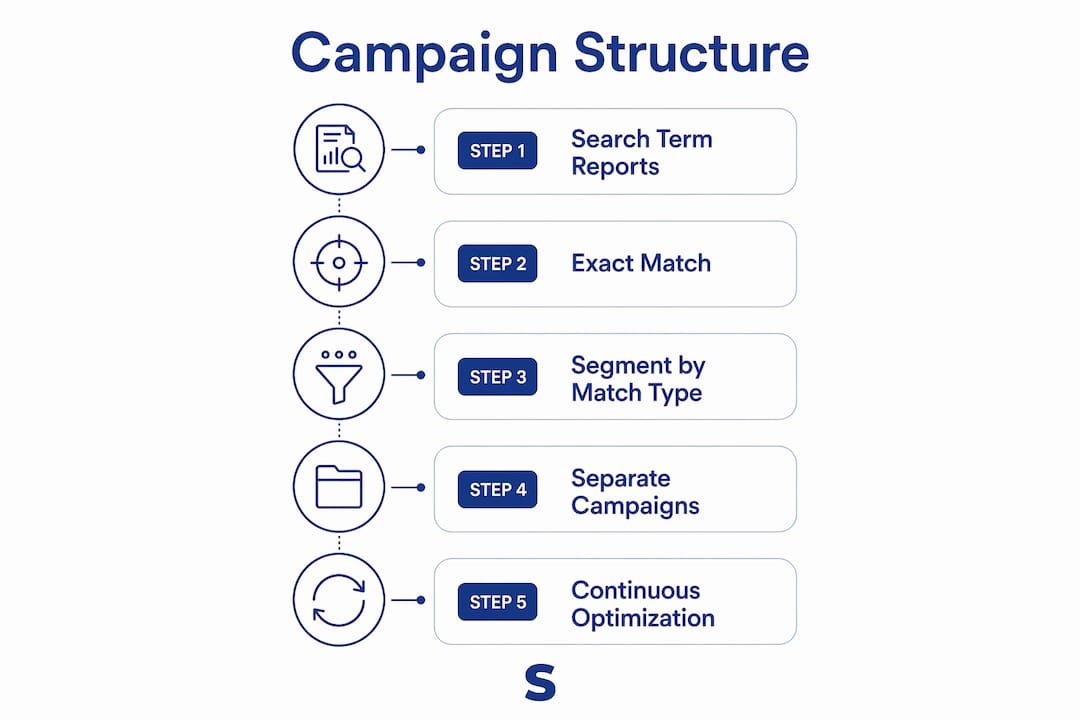
Build your baseline architecture like this:
- Auto campaign: One per product with a moderate daily budget. Let it run 7–14 days before making changes. Its only job is surfacing converting search terms.
- Manual exact match: Take your top 10–15 target keywords and bid aggressively. These are proven terms you know your buyers search.
- Phrase match: Captures long-tail variations the exact campaign misses. A keyword like “stainless steel water bottle” in phrase match also catches “stainless steel water bottle for kids.”
- Product targeting: Aim at 10–20 competitor ASINs at similar price points. Tests whether shoppers comparing options will choose your listing.
Pull your search term report weekly. Move any term with a few conversions into exact match, and immediately add it as a negative to your auto campaign so you control the bid precisely. For campaign structure guidance that goes deeper on this architecture, the principles hold regardless of your spend level.
Pro Tip: Segment campaigns by match type from day one. Mixing broad, phrase, and exact in a single ad group makes it nearly impossible to diagnose what is working when you start scaling spend.
Budget scaling and bid management that protect your margins
The small percentage budget increase rule exists for a reason. Amazon’s algorithm needs time to learn a new spend level, typically about a week or more. When sellers jump a campaign from $300 to $700 in one move, broad match terms pick up impressions on low-intent queries and ACoS spikes within 48 hours. The fix is patience, not a bigger budget.

Before calculating your target ACoS, calculate your break-even ACoS first. The formula is straightforward: net contribution margin divided by 1 equals your break-even ACoS. Net margin means sale price minus COGS, FBA fees, referral fees, and a returns reserve. Many sellers use gross margin and wonder why they are losing money at a “good” ACoS.
A few bid management tactics that move the needle:
- Dayparting: Analyze hourly conversion data over 30 days. Most consumer goods categories peak 7–10 PM EST. Cutting bids 40–60% during dead zones and redirecting that budget to peak windows can improve ACoS by 3–5 percentage points.
- Placement bid multipliers: Add a 40–60% multiplier for top-of-search placements, which convert at 2–3x the rate of rest-of-search in most categories. Reduce product page placements by 20–30%.
- Bid change discipline: Change bids by 10–15% at a time. Larger swings disrupt campaign learning and make it impossible to isolate what caused a performance shift.
Leveraging the 90-day honeymoon period for maximum ad impact
Amazon gives new listings a brief window where the algorithm actively tests them for sales velocity and conversion data. Miss this window and you are fighting for rank against established competitors with thousands of reviews. Use it well and you can build organic momentum that compounds for months.
The practical implication: spend 20–40% more than your long-term monthly ad budget during the first 90 days. Yes, you will lose money early. That concentrated spend buys data, visibility, and faster ranking. Pulling back at week five because ACoS looks bad is the single most common reason new listings stall.
Here is how the phases break down:
- Days 1–30 (launch): Auto plus broad match campaigns running aggressively. Target ACoS of 50–80%. Goal is keyword indexing and initial conversion data.
- Days 31–60 (optimize): Move winners into phrase and exact match. Add negatives aggressively. Target ACoS drops to 25–40%.
- Days 61–90 (scale): Exact match should represent 50–60% of total spend. Increase bids on keywords showing organic ranking improvement. Reduce auto and broad bids by 20–30%.
One thing that kills momentum faster than anything else: stockouts. Running out of inventory resets your PPC history and organic rank progress. Maintain 60–90 days of inventory coverage at all times and consider an FBA plus FBM hybrid setup as insurance.
How AI tools help startups compete with bigger ad budgets
Two years ago, managing one Amazon account well took 2–3 hours per week. Multiply that across a growing catalog and it becomes a full-time job before you have the revenue to justify one. AI-driven platforms change that math by automating the time-intensive work: bid adjustments, keyword harvesting, negative keyword suggestions, and campaign health scoring.
The specific advantage for startups is speed and accuracy. An AI platform can analyze dozens of campaigns simultaneously, flag high-spend low-return areas, and surface recommendations with the data justification attached. You see not just what to change but why, and then you track whether the change actually worked.
Selloop does exactly this. It analyzes your Sponsored Products and Sponsored Brands campaigns, identifies where ad budget is being wasted, and gives you clear, data-backed recommendations on which bids to adjust and which search terms to harvest or negate. Every change is tracked over a 21-day window so you can confirm whether it moved the needle. For startups that cannot justify agency pricing, that kind of AI-powered optimization at a fraction of the cost is a real competitive advantage.
Negative keyword hygiene alone, done systematically, reduces wasted spend by 15–25% within 60 days in mid-market accounts. AI tools make that process weekly instead of monthly.
Advanced targeting techniques that unlock new growth
Once your core Sponsored Products campaigns are profitable, the next layer is audience and product targeting that reaches buyers beyond search intent.
Sponsored Display lets you retarget shoppers who viewed your product page but did not buy, using a 7-day lookback window. These are warm audiences. Sponsored Brands serve a different function entirely: brand defense and new-to-brand acquisition. Track new-to-brand order rate and new-to-brand revenue as primary KPIs for Sponsored Brands, not ACoS. Optimizing Sponsored Brands purely for direct response misses the point of the format.
Product targeting campaigns aimed at competitor ASINs work especially well when you have a lower price point or stronger reviews. Start with 10–20 competitor ASINs at similar price points, then expand based on conversion data. Keep these in their own ad group, separate from keyword campaigns, so you can measure conquest efficiency independently.
For startups, Sponsored Display retargeting and competitor product targeting are the two highest-leverage additions after Sponsored Products are running well. DSP makes sense only once you are spending $30,000 or more per month on Sponsored ads and have listings with strong conversion rates.
Common scaling pitfalls that quietly destroy margins
Most scaling failures are not strategy failures. They are execution failures that compound over time.
Lump-sum budget increases are the most common. Doubling a daily budget in one move triggers poor bid optimization and wasted spend before the algorithm adjusts. The 10–20% rule exists precisely to prevent this.
Scaling before the listing is ready is equally damaging. More traffic to a listing with weak images, thin bullets, or no reviews just burns budget faster. Fix conversion rate before increasing spend.
Ignoring ASIN-level profitability is where many growing sellers lose money invisibly. Bid adjustments should be informed by per-ASIN net margin. Scaling a high-volume product with a 12% net margin after fees grows revenue while compressing profit. Rank your catalog by contribution margin, not sales volume, before deciding where to increase spend.
Avoiding common digital marketing mistakes like these early saves months of painful course correction later.
Testing and iterating ad creatives during scaling
Scaling spend on a creative that is not converting is expensive. Test main images, headline copy in Sponsored Brands, and video formats before committing significant budget.
Sponsored Brands video ads consistently outperform static formats. Launch video ads by days 60–90 once you have proven keywords and some creative assets in place. For Sponsored Products, the main image does the heavy lifting on click-through rate. A weak main image means your CTR is low, which means your effective CPC climbs even when bids stay flat.
Test placement modifiers on your top 5–10 keywords by increasing the top-of-search modifier to 50–100% for two weeks, then compare conversion rates and cost per acquisition. Let data decide, not assumptions about where buyers click.
Integrating Amazon ads with your broader marketing strategy
Amazon PPC does not operate in a vacuum. TikTok Shop drives discovery while Amazon closes the purchase. Customers who see a product on TikTok often search for it on Amazon where they have Prime and saved payment info. That cross-platform effect is measurable and worth building into your growth plan.
Brand equity built off Amazon raises your organic conversion rate on Amazon. The more buyers recognize your brand before they land on your listing, the higher your conversion rate without any change to bids or budget. For startups, this means even modest off-Amazon content investment pays dividends in PPC efficiency.
Treat Amazon as a P&L, not just a sales channel. Know your true landed cost per unit including product cost, shipping to Amazon, FBA fees, referral fees, PPC spend, returns, and storage. Many founders think they are running 30% margins but are actually at 12% after all Amazon costs. That gap is where scaling decisions go wrong.
Selloop gives startups a smarter path to profitable Amazon growth
Most startups scaling Amazon ads face the same problem: too many campaigns to monitor manually, too little time to act on the data, and agency pricing that does not make sense at their revenue level.
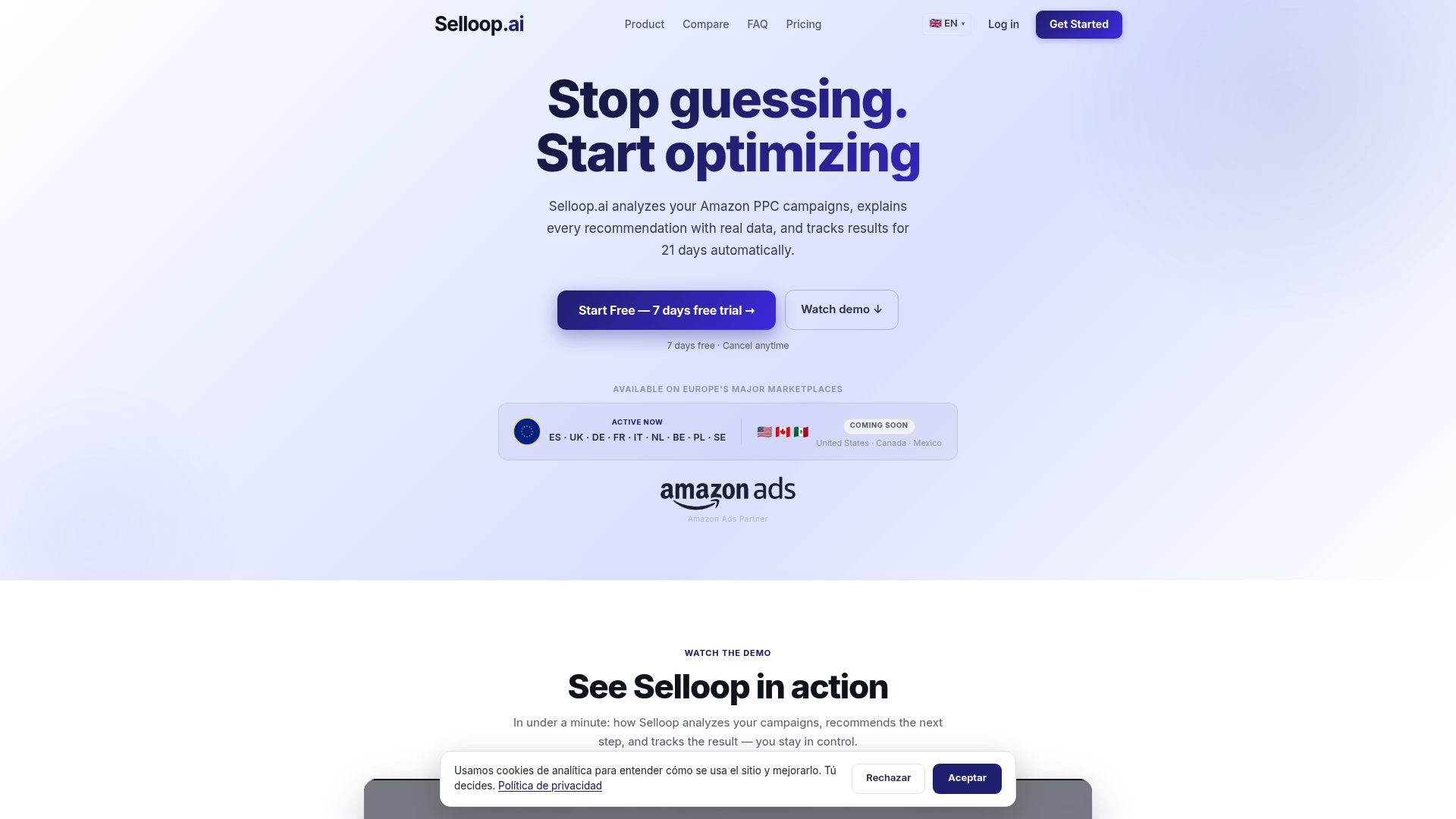
Selloop is built for exactly this situation. It analyzes your Sponsored Products and Sponsored Brands campaigns, pinpoints where ad spend is being wasted, and delivers data-justified recommendations on bids, keywords, and negatives. You approve each change with one click. Selloop applies it on Amazon and tracks the result over 21 days so you know whether it worked. No spreadsheets, no guesswork, no agency retainer. Plans start at €29/month with a 7-day free trial. If you are ready to stop losing money on underperforming campaigns, start your free trial at Selloop today.
Key Takeaways
Startups that scale Amazon ads profitably combine structured campaign architecture, disciplined budget increases of no more than 10–20% at a time, and TACoS as the primary health metric rather than ACoS alone.
| Point | Details |
|---|---|
| Campaign structure | Run one auto campaign plus manual exact, phrase, and product targeting campaigns from day one. |
| Budget allocation | Direct over 80% of early spend to Sponsored Products for maximum search visibility. |
| Budget scaling rule | Increase campaign budgets by no more than 10–20% at a time, with 2–3 weeks of stable data between moves. |
| Honeymoon period | Spend 20–40% more than your long-term monthly budget during the first 90 days to build rank and data. |
| Selloop | Selloop analyzes campaigns, flags wasted spend, and tracks every change over 21 days, starting at €29/month. |