Prestozon Review 2026: Is It Worth It for Amazon Sellers?

Prestozon is a solid pick for mid-size Amazon sellers who want real automation without handing over full control to a black-box algorithm. If you’re spending at least a few hundred dollars a month on ads and you’re tired of managing bids in spreadsheets, it’s worth a trial. If you’re a beginner with a tiny budget or you need same-day attribution, it’s probably not the right fit yet.
TL;DR:
- Fit: Best for sellers running Sponsored Products and Sponsored Brands who want bid automation with some visibility into the logic
- Pricing shape: Spend-based tiers; the free trial tier includes live automation on a limited number of campaigns, allowing you to test the platform with your own data before paying
- Core automation: Keyword harvesting, negative keyword suggestions, and ACoS-driven bid optimization are the main draws
- Caveat: Premium support kicks in at higher spend levels; attribution lag means you won’t see results overnight
Table of Contents
- What is Prestozon and which Amazon ad types does it cover?
- How does Prestozon’s automation actually work?
- What does Prestozon cost and what does the free trial include?
- Which sellers should use Prestozon and who should skip it?
- Prestozon pros and cons from real user signals
- What performance improvements should you realistically expect?
- Prestozon vs. Selloop: which platform fits your situation?
- Should you trial Prestozon right now?
- Key takeaways
- Our perspective on this Prestozon review
- Selloop: the transparent alternative worth trying
- Useful sources for verifying Prestozon facts
What is Prestozon and which Amazon ad types does it cover?
Prestozon is an Amazon Advertising partner that automates the most time-consuming parts of PPC management: bid adjustments, keyword harvesting from search term reports, and negative keyword suggestions. It covers Sponsored Products and Sponsored Brands campaigns, which handles the majority of what most sellers run.

It works for both solo sellers and agencies managing multiple client accounts, though the agency workflow is more polished at higher spend tiers. Marketplace coverage is primarily focused on Amazon US, with some support for other Amazon marketplaces depending on account setup.
How does Prestozon’s automation actually work?
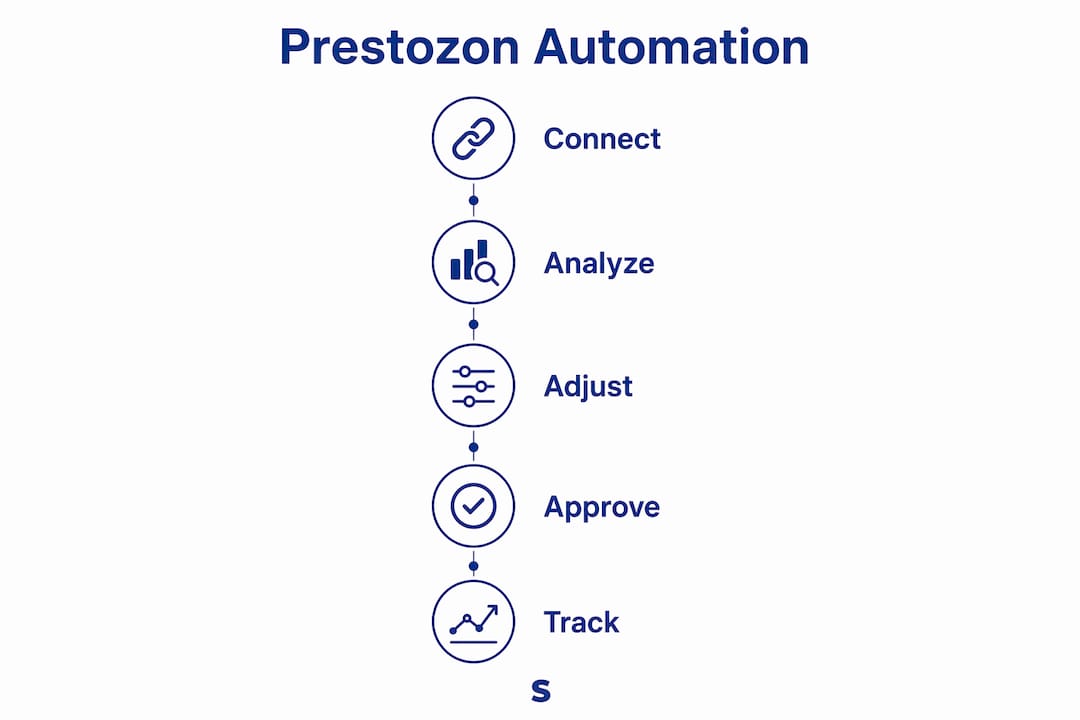
The platform sits between fully manual bidding and a black-box automation tool. You set a target ACoS, and Prestozon’s algorithm adjusts bids toward that goal based on historical performance data. That’s the core loop.
Key features:
- Automated bid optimization: Bids move up or down based on keyword-level ACoS relative to your target
- Keyword harvesting: Pulls converting search terms from auto and broad campaigns and suggests them as exact or phrase match targets
- Negative keyword suggestions: Flags non-converting search terms for negation, reducing wasted spend
- Campaign structure tools: Helps set up single-keyword campaigns (SKAGs) for tighter control
- Reporting and analytics: Dashboard shows bid history, keyword performance, and ACoS trends over time
Where Prestozon earns credit is transparency. You can see why a bid changed, which is more than most fully automated tools offer. Comparative reviews position it as a favorite among sellers who want more control than black-box platforms but more automation than a manual spreadsheet.
The system can apply changes automatically or queue them for manual approval. Most experienced users start with manual approval to build confidence, then shift to auto-apply once they trust the algorithm’s direction.

Pro Tip: Set your automation to manual approval for the first two weeks. Amazon’s attribution window means conversion data lags by 24–48 hours, so the algorithm needs time to learn. Approving changes manually during this period lets you catch any aggressive bid swings before they burn budget.
What does Prestozon cost and what does the free trial include?
Prestozon uses spend-based pricing tiers, meaning your monthly cost scales with how much you spend on Amazon ads. Annual billing typically comes with a discount versus month-to-month. Exact current pricing isn’t publicly listed in a single place, so checking the vendor’s pricing page directly is the most reliable approach.
The free trial tier is genuinely useful. It includes live automation for a limited number of campaigns, so you can evaluate the tool’s impact on your real ad data before deciding on a paid tier.
Recommended trial plan: Pick two or three of your highest-spend campaigns. Set a clear baseline (your current ACoS and weekly spend) before you activate automation. Run it for 14–21 days, then compare. That window accounts for attribution lag and gives the algorithm enough data to act meaningfully.
Which sellers should use Prestozon and who should skip it?
| Seller profile | Good fit? | Why |
|---|---|---|
| Solo seller, small catalog, low monthly ad spend | Maybe | Free trial allows for real testing on a few campaigns; premium support and full features may require higher spend |
| Mid-size seller, $500–$5,000/month, multiple campaigns | Yes | Core automation delivers real time savings; bid logic is well-suited for sellers in this spend range |
| Agency managing multiple client accounts | Yes, at higher tiers | Multi-account workflow works, but premium onboarding is spend-gated |
| Beginner with no PPC baseline data | Skip for now | Algorithm needs historical data to work well; manual setup first makes more sense |
| Seller needing same-day attribution or instant negation | Skip | The 24–48 hour attribution delay makes real-time response impossible |
If your ad spend is very low or your catalog is brand new, the algorithm simply doesn’t have enough signal to optimize effectively. Build some manual history first, then bring in automation.
Prestozon pros and cons from real user signals
Pros:
- Saves meaningful time on bid management and search term analysis
- Keyword isolation workflow (SKAGs) is well-implemented and reduces wasted spend
- ACoS-focused suggestions are easy to understand and act on
- Setup is relatively fast; the UI is clean and doesn’t require a steep learning curve
- Amazon Advertising partner status adds a layer of credibility
Cons:
- Premium support is tiered by ad spend; lower-spend accounts may find response times slower
- Attribution lag means the system can’t react instantly to bad search terms
- Occasional UI glitches reported by users, particularly on lower-spend accounts
- Marketplace coverage outside Amazon US can be limited depending on your setup
- Pricing transparency requires checking the vendor page directly; public sources vary
“Prestozon sits in a useful middle ground — it automates the routine work without making you feel like you’ve lost the wheel entirely. The bid logic is explainable, which matters when you’re trying to learn while you optimize.” — Amazon PPC tools roundup, PickFu
What performance improvements should you realistically expect?
No tool guarantees a specific ACoS drop, and anyone who tells you otherwise is selling you something. What Prestozon can do is remove the human delay from bid adjustments and keyword decisions, which compounds over time.
The platform reportedly processes extensive data daily according to vendor summaries, which gives the algorithm a broad training base. That scale matters for bid confidence, especially on competitive keywords.
Practical measurement checklist:
- Record your baseline ACoS, ROAS, and weekly ad spend before activating automation
- Run the tool for at least 14 days before drawing conclusions (21 days is better)
- Compare the same campaigns, not your whole account, to isolate the effect
- Watch for ACoS volatility, not just average ACoS; a lower average with wild swings is not a win
- Check conversion rate alongside ACoS, since bid changes affect both
The attribution delay is the most common reason sellers misjudge early results. A keyword that looks like it’s burning money on day three may have conversions still attributing. Patience during the observation window is the single most important discipline.
Prestozon vs. Selloop: which platform fits your situation?
| Dimension | Prestozon | Selloop |
|---|---|---|
| Best for | Mid-size sellers and agencies wanting ACoS-driven automation with visible logic | Small to mid-size sellers wanting AI-driven recommendations with full transparency and low cost |
| Pricing & trial | Spend-based tiers; free trial includes live automation on a limited number of campaigns | Plans from €29/month; 7-day free trial |
| Core automation | Bid optimization, keyword harvesting, negative keyword suggestions, SKAG setup | Bid recommendations, keyword harvesting, negative keyword suggestions, campaign health scoring |
| Transparency / control | Manual approval or auto-apply; bid change history visible | One-click approval per recommendation; data justification shown for every suggestion |
| Result tracking window | No defined platform-level tracking window stated publicly | 21-day tracking window per change; confirms whether each decision worked |
| Support & onboarding | Tiered by ad spend; premium support at higher levels | Direct support; built by an experienced Amazon seller |
| Ease of use / UI | Clean UI; relatively fast setup | Designed for sellers without a PPC background; no spreadsheets required |
Prestozon makes sense if you’re already comfortable with Amazon PPC concepts and you want a well-established tool with a track record. Selloop is the stronger choice if you want to see exactly why each recommendation was made and confirm whether it actually moved the needle, especially at a lower price point. The 21-day result tracking window is a genuine differentiator: most tools tell you what to do, but Selloop tells you whether it worked.
Should you trial Prestozon right now?
Yes, if you’re spending at least a few hundred dollars a month on Amazon ads and you’ve been managing bids manually. The free trial provides live automation for a limited number of campaigns, which is enough for a meaningful assessment.
Next steps for a low-risk trial:
- Activate automation on two or three campaigns, not your whole account
- Set a target ACoS that reflects your actual margin, not an aspirational number
- Use manual approval for the first two weeks to monitor bid direction
- Check results after 21 days against your pre-trial baseline
- If support response is slow, note whether your spend level qualifies for premium access
One risk check worth flagging: if your total ad spend is very low, the spend-based pricing model may make the paid tiers feel expensive relative to the savings. Run the math before upgrading from the free tier.
Key takeaways
Prestozon is a capable, mid-market Amazon PPC tool that automates the right things, but its value scales with your ad spend and your willingness to give the algorithm time to learn.
| Point | Details |
|---|---|
| Best fit by spend | Mid-size sellers spending $500+ per month on Amazon ads get the most from Prestozon’s automation |
| Free trial is real | The trial tier includes live automation on a limited number of campaigns, so you can test its performance with your own data before subscribing |
| Attribution lag matters | Allow a couple of weeks before judging results; the Amazon attribution delay skews early readings |
| Support is tiered | Premium support requires higher ad spend; lower-spend accounts should set realistic expectations |
| Selloop alternative | Selloop offers per-recommendation transparency and a 21-day result tracking window from €29/month |
Our perspective on this Prestozon review
The most underrated question in any PPC tool evaluation isn’t “does it lower my ACoS?” It’s “can I tell why it made that decision, and can I confirm it worked?”
Most sellers focus on the before-and-after ACoS number and miss the fact that correlation and causation are genuinely hard to separate in Amazon advertising. Seasonality, competitor behavior, and organic rank changes all move ACoS independently of your bids. A tool that shows you the decision logic and then tracks whether that specific change produced the expected result is worth more than one that just moves numbers around.
Prestozon does better than most on the transparency side. But the absence of a defined, per-change result tracking window means you’re still doing the attribution math yourself. That’s fine if you have the discipline and the spreadsheet skills. If you don’t, or if you’d rather spend that time on sourcing and product development, a tool that closes that loop for you is the smarter investment.
Selloop: the transparent alternative worth trying
If Prestozon’s spend-based pricing puts the best features out of reach, or you want to know whether each individual bid change actually paid off, Selloop was built for exactly that situation.
Selloop analyzes your Sponsored Products and Sponsored Brands campaigns, flags where your budget is going to waste, and gives you a clear, data-backed reason for every recommendation. You approve it with one click. Then Selloop tracks that specific change over 21 days and shows you the result. No spreadsheets, no guessing, no waiting to find out if the algorithm was right.
Plans start at €29/month with a 7-day free trial. It’s built by an Amazon seller who spent over a decade managing campaigns across European marketplaces, so the logic reflects how real accounts behave, not just how algorithms are supposed to work in theory.
Start your free trial at Selloop and run it alongside your current setup to see the difference in one billing cycle.
Useful sources for verifying Prestozon facts
- Serchen — Prestozon product details and reviews: Aggregated user reviews and product overview; good for independent sentiment
- Amazon Seller Hub — Prestozon review and pricing: Pricing context and feature summaries updated for 2026
- Mofluid — Prestozon reviews, pricing and coupon code: Trial tier details and platform-reported dataset claims
- GroupBuyExpert — Prestozon reviews: Spend-based pricing tiers and user-reported support limitations
- Shopkeeper — Amazon PPC software tools: UI assessment and attribution delay notes
- PickFu blog — Best Amazon PPC tools: Comparative positioning and automation style context
- EcomCrew — Best Amazon software: Seller community perspective on Prestozon’s market position
- Selloop.ai: Publisher’s own product page; features, trial offer, and 21-day tracking window details