Top 3 Teikametrics Review Software Alternatives 2026

Managing Amazon ad campaigns and keywords across multiple marketplaces eats hours every week without clear feedback on changes. Traditional tools rely on short-term metrics, hide logic behind recommendations, or lack unified dashboards, leaving sellers and agencies guessing about real results. This article compares pricing, automation, and data visibility across three Amazon PPC optimization platforms so sellers and agencies can pick a solution that matches their account needs.
Table of Contents
Selloop.ai
At a Glance
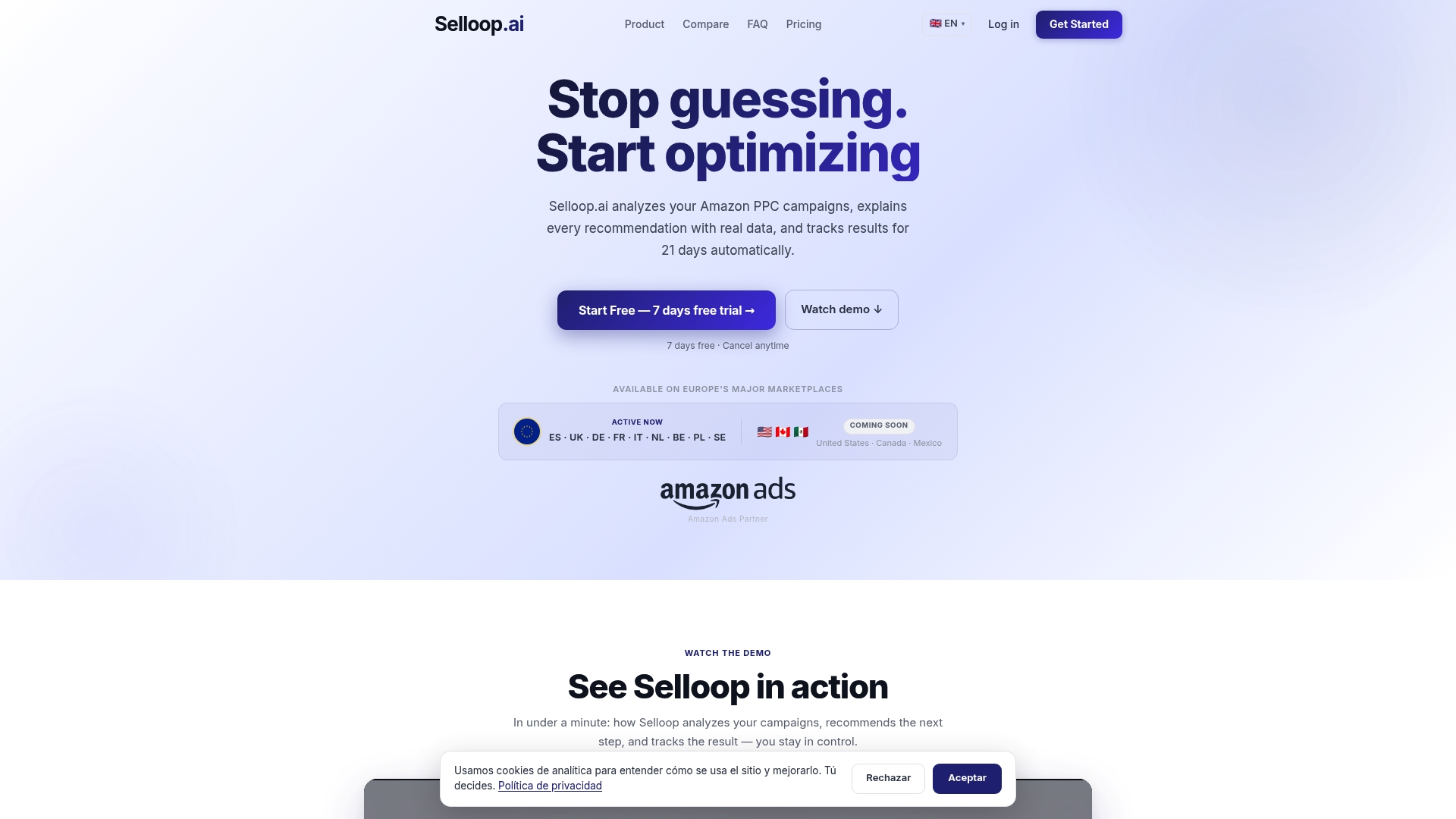
Selloop automatically tracks the impact of campaign changes for 21 days and issues a clear verdict on whether each change helped performance. The interface highlights wasting campaigns and surfaces winning keywords without manual spreadsheet work. That tracking model reduces the guesswork sellers face when testing bids and negative keywords.
Core Features
Selloop runs deep analysis across PPC campaigns and explains every AI recommendation with data-backed context so you can see why a suggestion appears. The platform harvests profitable search terms automatically and enables real-time monitoring and alerts across European marketplaces. It supports multiple ad accounts and centralizes results so agencies and sellers manage several client or brand accounts from one dashboard.
Key Differentiator
The central differentiator is transparent, data-backed explanations for all AI-driven recommendations. Each suggestion includes the metrics and filters that led to it so you can audit the logic before you act. That clarity reduces blind trust in automation and makes it easier to justify changes to stakeholders or clients.
Pros
Selloop has an affordable entry point at €29/mo, which lowers the barrier for small sellers to try automated PPC analysis. The AI explains recommendations rather than presenting black-box edits, so you can validate rules with actual campaign data. Automated keyword harvesting and multi-account support save hours when you scale across marketplaces, and the 21-day tracking shows whether changes landed rather than guessing from short-term volatility.
Cons
- Best suited for small to mid-sized sellers and agencies managing moderate ad spend; very high ad spend accounts will likely need an enterprise plan.
Notable Integrations
Selloop connects to the Amazon Ads API for campaign data ingestion and reporting. That connection lets the tool pull search term and performance data automatically. Users must authorize API access for full automation and for the platform to harvest keywords and track 21-day outcomes.
Who It’s For
This tool fits small to medium-sized Amazon sellers and digital marketing agencies running multiple client accounts across European marketplaces. It also suits sellers who test frequent bid or keyword changes and want a recorded outcome window. Sellers with very large monthly ad budgets should evaluate enterprise options.
Unique Value Proposition
Tracks and evaluates every recommendation for a full 21-day window so you stop judging performance on noisy, short-term swings. That measurement approach removes spreadsheet-based A/B tracking and gives you a single place to see whether a bid or negative keyword change produced a real result. The workflow cuts time spent on manual follow-up and makes ACoS discussions with clients more evidence based.
Real World Use Case
The vendor reports a 24% reduction in ACoS for a seller who used Selloop to identify underperforming campaigns and apply recommended changes. In practice, the seller reviewed the explanation for each recommendation, applied selected edits, and let Selloop track the effect over the 21-day window to confirm wins before scaling them.
Pricing
Plans start at €29/mo for Starter, scale to €99/mo for Growth, and €249/mo for Pro. The company offers custom pricing for agencies and large accounts that need multiple ad account seats or higher data volumes. Pricing tiers map to the depth of analysis and number of managed marketplaces.
Website: https://selloop.ai
atom11
At a Glance
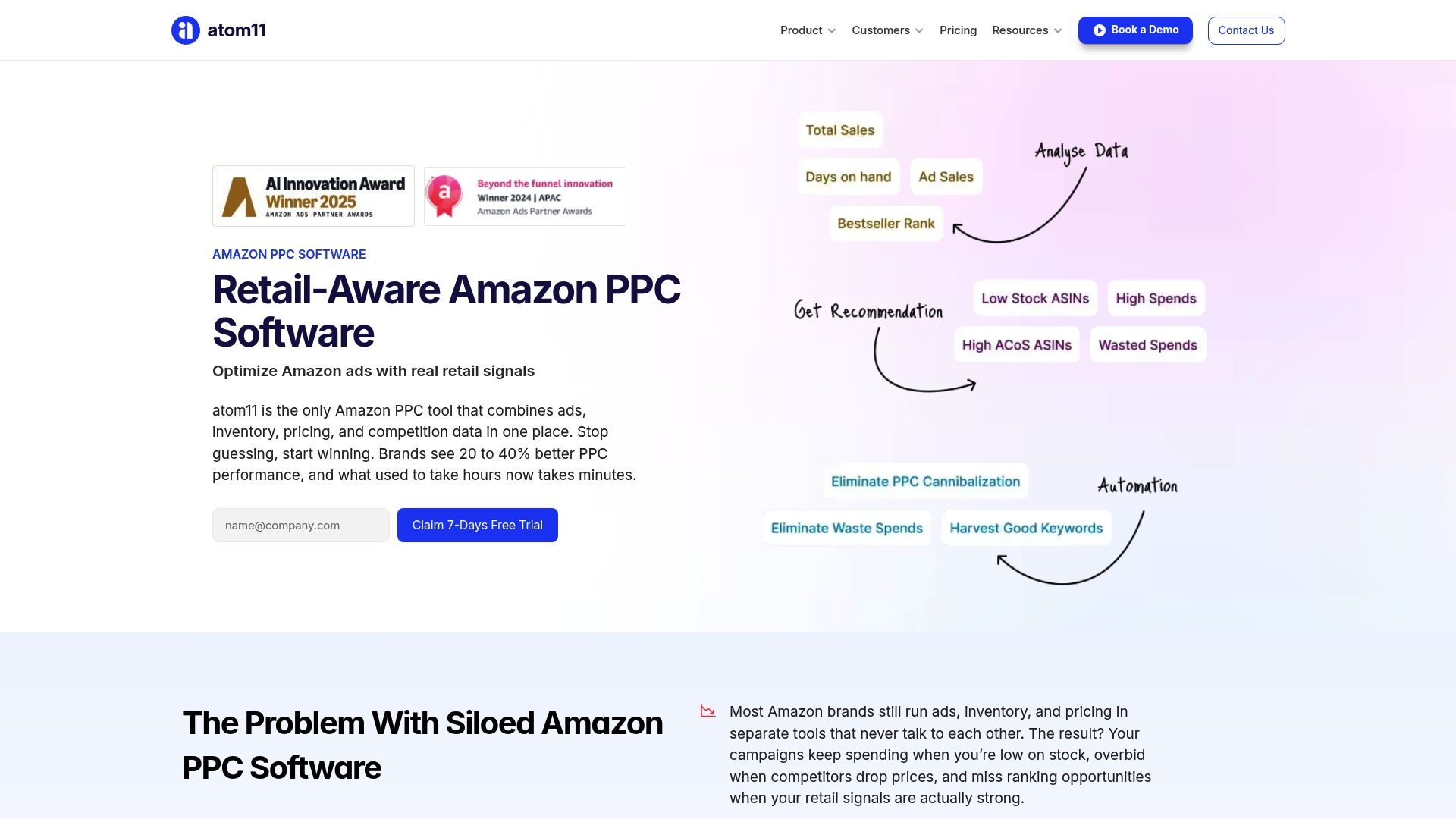
The vendor advertises 20 to 40% better results when bids and budgets use retail signals. atom11 combines ads, inventory, pricing, and competitive data so campaign actions reflect real retail conditions. Sellers report the platform reduces manual bid work by centralizing those signals in one dashboard.
Core Features
atom11 provides bid optimization that uses inventory and pricing signals, a Root Cause Analyzer for sudden performance drops, and dayparting to schedule bids by hour and weekday. The platform includes AI Copilot Neo for analysis and recommendations, version control for safe testing, keyword harvesting and negation tools, and Digital Shelf Tracking for listing monitoring. Power BI integration allows export of raw data for deeper reporting.
Key Differentiator
The defining angle is that automation and rules run on live retail signals rather than solely on ad metrics. That means bids, budgets, and campaign rules can react to inventory levels, buy box status, and pricing changes in real time. This approach narrows automation to retail moments that actually affect conversions and profit.
Pros
The system ties inventory and buy box conditions directly to bid logic, which cuts the guesswork when sales patterns change. The Root Cause Analyzer speeds diagnosis so you do not chase unrelated keywords after a performance drop. atom11 automates many manual adjustments, freeing time for strategy and creative work. The vendor reports the platform is trusted by over 1,000 brands, agencies, and sellers, which suggests adoption by multi-account managers.
Cons
-
Complex setup and training required. New users need time to map inventory and pricing feeds to bid rules.
-
Pricing transparency varies across sources. Some buyers report differences in final quotes for higher spend accounts.
-
Effectiveness depends on correct configuration and retail data availability. Poor feeds reduce the value of the retail-aware automation.
When It May Not Fit
If you run a single low-volume SKU or keep tight manual control over every bid, atom11 may be more tool than you need. Teams without reliable inventory or buy box data will see weaker results. Agencies that need simple, spreadsheet-style workflows rather than integrated retail signals may prefer lighter solutions.
Notable Integrations
-
Amazon Seller Central
-
Amazon Vendor Central
-
Power BI
Who It’s For
Sellers, brand managers, and agencies that manage Amazon ad accounts and want their bidding to reflect real retail conditions. Companies with fluctuating inventory or active pricing strategies will gain the most. Multi-account agencies that need centralized automation across client stores will also benefit.
Real World Use Case
According to the company, a seller increased ROAS by 30% within the first few weeks after connecting inventory and pricing feeds and enabling dayparting. The team used the Root Cause Analyzer to isolate a loss in organic placement and adjusted bids only on affected campaigns. That focused work reduced wasted spend while preserving profitable keywords.
Pricing
Plans start at $499/month for Beginner up to $50K ad spend, the Professional tier is $1,199/month for up to $500K ad spend, and Enterprise pricing is custom for higher spend and needs. Pricing appears tiered by ad spend and account complexity.
Website: https://atom11.co
DataFuel
At a Glance
The vendor advertises savings of 20+ hours per week for brands through unified analytics and automation. DataFuel targets ecommerce and quick commerce advertisers by combining a unified dashboard with campaign automation and dayparting. Starter plans begin at $449 per month and scale toward enterprise pricing.
Core Features
A single dashboard consolidates performance across Amazon, Blinkit, Zepto, Instamart, and other marketplaces while showing inventory and ad metrics in one view. Advanced automation manages bids, keywords, and bulk campaigns, and the Campaign Launcher speeds large scale campaign creation. Dayparting lets you shift spend by time of day and receive real time alerts for sales or stock swings.
Key Differentiator
DataFuel pairs broad marketplace integrations with automation and a unified analytics view to reduce manual work. That claim about weekly time savings appeals to teams that need to cut reporting and repetitive bidding tasks.
Pros
It consolidates cross platform data so you can review ad performance, inventory, and alerts without switching tools. Automation reduces repetitive work by adjusting bids and keywords and by enabling bulk campaign operations. Real time tracking helps you react to sales and stock changes, and deep integrations reduce custom API work for agencies.
Cons
-
Walmart and Flipkart support are listed as coming soon, so true multi platform management is limited at launch.
-
Starter pricing at $449 per month may be steep for smaller sellers or accounts with low ad spend.
-
Advanced features increase setup complexity and will require onboarding or training for teams new to automation.
When It May Not Fit
If you run only Amazon accounts and need a low cost tool, DataFuel’s price and breadth may be overkill. Smaller brands with minimal ad budgets may prefer a cheaper toolkit until they reach scale. Teams that need immediate Flipkart or Walmart management will face limits while those integrations roll out.
Notable Integrations
-
Amazon Advertising API
-
Walmart API (coming soon)
-
Flipkart Ads (coming soon)
-
Blinkit
-
Zepto
-
Instamart
Who It’s For
Brands and agencies managing marketplace advertising who want automation and a single view of campaign performance will get the most from DataFuel. Quick commerce sellers that coordinate inventory and ads across Blinkit, Zepto, and Instamart will find the platform relevant.
Real World Use Case
A brand uses dayparting to raise bids during peak hours and lower bids overnight, then measures results in the unified dashboard. That workflow reduces manual bid edits and consolidates reporting across Amazon, Flipkart, and Blinkit.
Pricing
Starter starts at $449 per month. Growth is listed at $599 per month, and enterprise pricing is custom for spend above $40,000 per month.
Website: https://datafuel.tech
Comparison of alternatives
Selecting the right Amazon PPC optimization software depends on understanding key functionalities that streamline campaign management while delivering measurable results.
Transparent recommendations vs. retail-aware automation
Selloop.ai differentiates itself with its focus on transparent, data-backed AI recommendations. Every adjustment suggested by the software is accompanied by clear justifications and attributable campaign data, which simplifies validation and facilitates stakeholder communication. In contrast, atom11’s primary advantage lies in its retail-aware automation, which integrates live inventory and market condition data into bidding strategies. This feature ensures campaign activities dynamically align with real-time retail opportunities.
Scalability and platform integrations
DataFuel excels in catering to extensive cross-platform advertisers, offering integrations with multiple ecommerce platforms alongside its powerful automation suite. This scalability is particularly beneficial for agencies managing diverse client portfolios. Selloop.ai, however, focuses on providing advanced PPC optimizations within European Amazon marketplaces, making it uniquely suited for businesses within this niche.
Best fit
-
Small to medium-sized Amazon sellers needing transparency in campaign changes can rely on Selloop.ai, as its 21-day performance verdict feature eliminates guesswork.
-
Agencies managing high spend client accounts, where live inventory and pricing dynamics drive decisions, may find atom11 more effective.
-
Businesses advertising across multiple ecommerce platforms, requiring consolidated reporting and management tools, benefit most from DataFuel.
Our pick
Selloop.ai demonstrates clear strengths through its transparent recommendation process and affordability, making it a choice for Amazon sellers seeking evidence-based implementation approaches. While specific needs such as retail dynamics or expansive platform coverage may direct users to alternatives, Selloop.ai’s innovations solidify its position as a leading tool for optimizing Amazon PPC campaigns.
For Amazon PPC optimization platforms, the following comparison highlights differences in features, pricing, and suitability.
| Product | Key Differentiator | Best For | Pricing | Notable Limitation |
|---|---|---|---|---|
| Selloop | Data-backed AI recommendations with context | Small and medium-sized sellers | €29/mo Starter Plan | Focused on moderate ad spend accounts |
| atom11 | Retail signal-based bid optimization | Multi-account management | $499/mo Beginner Plan | Requires robust inventory and pricing feeds |
| DataFuel | Unified dashboard across marketplaces | Quick commerce and large brands | $449/mo Starter Plan | Limited support for Walmart and Flipkart |
How Can Amazon Sellers Track True PPC Impact Beyond Short-Term Swings?
Amazon sellers and agencies often struggle with knowing if bid or keyword changes actually improve performance over time. Relying on short-term data or spreadsheets leaves too much uncertainty, especially when managing multiple campaigns across marketplaces. Selloop addresses this by tracking every campaign change for a full 21-day window, allowing sellers to spot winning strategies and wasted spend with clear, data-backed explanations.
• Designed for small to medium sellers and agencies managing several client accounts • Automatically harvests profitable keywords and monitors European marketplaces • Removes manual tracking by highlighting results in a single dashboard
Stop second-guessing your PPC moves. Learn how Selloop helps you verify campaign results over the right time frame and optimize ad spend with confidence.
See Selloop’s approach to data-driven PPC monitoring
Get started with Selloop’s 21-day outcome tracking today
FAQ
What is a key feature of Selloop for PPC optimization?
Selloop automatically tracks the impact of campaign changes for 21 days. This tracking model provides sellers with clear insights on whether their changes helped performance, reducing guesswork during bid and keyword adjustments.
How does Selloop compare to atom11 for managing ad accounts?
atom11 excels in providing bid optimization using live retail signals, which allows campaigns to react to inventory and pricing changes in real time. Selloop, on the other hand, is better suited for small to mid-sized sellers who want a transparent analysis of campaign performance across multiple ad accounts without the complexity of real-time retail signals.
Which platform offers keyword harvesting features?
Selloop includes automated keyword harvesting, streamlining the process of finding profitable search terms. This feature saves time for sellers who need to scale their campaigns effectively across various marketplaces.
Can Selloop handle multiple ad accounts?
Yes, Selloop supports multiple ad accounts, allowing agencies and sellers to manage several client or brand accounts from one centralized dashboard. This feature is particularly beneficial for sellers who operate in diverse markets and need efficient management tools.
What pricing options does Selloop offer?
Selloop offers plans starting at €29 per month, providing an affordable entry point for small sellers to begin utilizing automated PPC analysis. It also includes higher tiers for growing needs, making it accessible for businesses at various stages.