Best Automated Tools for Amazon Sellers in 2026
The strongest automated tools for Amazon sellers in 2026 cover five core jobs: product research, listing optimization, PPC management, inventory control, and analytics. No single tool wins every category, but a handful of platforms come close, and knowing which one fits your operation saves real money.
Here are the leading options by category:
-
Product research: Helium 10, Jungle Scout, SmartScout, AMZScout, Data Dive, ZonGuru
-
Keyword and listing optimization: Keywords.am, DataHawk, Helium 10, ZonGuru
-
PPC and advertising automation: Perpetua (by Pacvue), Quartile, Intentwise, SellerApp, Seller Snap
-
Inventory and operations: InventoryLab, Carbon6, Sellerboard, Shopkeeper
-
Analytics and profit tracking: SellerLegend, HelloProfit, Nova Analytics, Sellerboard
-
Customer service and reputation: FeedbackWhiz
-
Creative and visuals: VistaCreate
-
Amazon native tools: Amazon Seller app, Automate Pricing, Veeqo
Amazon’s own free seller tools handle repricing, mobile order management, and multichannel shipping without a subscription. Third-party platforms layer on deeper intelligence, automation depth, and cross-tool integrations that Seller Central alone cannot match.
What are the best automated tools for Amazon sellers?
Every major tool category serves a distinct part of the seller workflow. The table below maps each featured platform to its category, standout features, pricing model, and ideal user.
| Tool | Category | Key Features | Pricing | Ideal User | Unique Benefit |
|---|---|---|---|---|---|
| Helium 10 | All-in-one | Keyword research, listing builder, PPC insights, analytics | Tiered plans; free tier available | Sellers wanting one broad platform | Deep keyword and listing toolset in one suite |
| Nova Analytics | Analytics / PPC | AI campaign analytics, multi-account management | Not publicly listed | Medium to large sellers | Multi-account AI optimization at scale |
| Amazon Seller app | Native / Operations | Order management, repricing, inventory alerts | Free | New or budget-conscious sellers | Native Amazon integration, zero cost |
| SmartScout | Product research | Competitor intelligence, niche data, brand mapping | Tiered plans | Data-driven sourcing sellers | Proprietary market-share data by subcategory |
| Jungle Scout | Product research | Sales estimates, supplier database, niche finder | Tiered plans | Private label sellers | Integrated supplier sourcing with demand forecasting |
| SellerApp | All-in-one / PPC | Keyword tracking, PPC bid automation, product research | Tiered plans | Sellers wanting research plus ad automation | Automated bid management alongside research |
| Perpetua (by Pacvue) | PPC automation | AI bid optimization, multi-channel campaigns | Percentage of ad spend | Brands and agencies scaling ads | Multi-channel PPC strategy with AI-driven goals |
| Keywords.am | Keyword research | Real-time keyword data, PPC and SEO targeting | Tiered plans | Listing and PPC keyword-focused sellers | Real-time keyword volume for ad campaigns |
| VistaCreate | Creative design | Design templates, product imagery, promotional graphics | Free and paid tiers | Sellers needing fast listing visuals | Amazon-specific design templates |
| SellerLegend | Analytics / Operations | Profitability dashboard, workflow automation, sales data | Tiered plans | Sellers wanting financial plus operational view | Links sales data directly to operational workflows |
| Sellerboard | Profit analytics / PPC | Real-time profit calculation, PPC performance, inventory | Tiered plans | Sellers tracking margin alongside ad spend | Live profit view combined with PPC data |
| HelloProfit | Profit analytics | Visual dashboards, advertising ROI tracking | Tiered plans | Analytical sellers monitoring ROI | Simplified visual reporting for complex data |
| FeedbackWhiz | Reputation management | Automated review requests, feedback monitoring | Tiered plans | Sellers focused on review growth | Automated follow-up workflows for feedback |
| DataHawk | SEO / Analytics | Keyword rank tracking, competitor intelligence, market data | Tiered plans | Sellers needing deep SEO and market analytics | Comprehensive competitor and keyword tracking |
| Quartile | PPC automation | Machine-learning bid optimization, predictive analytics | Percentage of ad spend | Sellers wanting ML-powered ad bidding | Predictive budget allocation across campaigns |
| InventoryLab | Inventory / Accounting | Inventory tracking, restocking, profitability reports | Tiered plans | FBA sellers managing stock and financials | Accounting integrated with inventory control |
| Seller Snap | PPC / Listing | AI bid management, listing quality scoring | Tiered plans | Sellers needing AI for both ads and listings | Real-time listing quality score alongside bid data |
| Carbon6 | Repricing / Inventory | Rule-based repricing, stock management | Tiered plans | Sellers needing dynamic pricing automation | Repricing tied directly to inventory levels |
| AMZScout | Product research | Supplier database, demand scoring, competition data | Tiered plans | Private label and wholesale sellers | Demand and competition scoring in one view |
| Data Dive | Market research | Sales estimates, trend dashboards, market insights | Tiered plans | Sellers wanting clear market trend data | Easy-to-read dashboards for market validation |
| ZonGuru | All-in-one | Product research, listing optimization, operations | Tiered plans | Sellers wanting research and operations combined | Integrated product discovery with workflow tools |
| Intentwise | PPC analytics | Bid automation, campaign analytics, keyword management | Tiered plans | Sellers focused on advertising intelligence | Detailed campaign analytics with auto bid control |
| Shopkeeper | Profit / PPC | Financial dashboards, ad-spend monitoring, inventory planning | Tiered plans | Sellers monitoring profitability and ad ROI | Clear financial view with integrated PPC data |
Product research tools like Jungle Scout and SmartScout pull sales estimates, competition scores, and supplier data to validate ideas before you spend a dollar on inventory. SmartScout’s subcategory market-share mapping is genuinely hard to replicate elsewhere. Jungle Scout adds a supplier database that connects product validation directly to sourcing, which cuts a step most sellers handle manually.
Listing and keyword tools such as Keywords.am and DataHawk focus on the search-visibility side. Keywords.am delivers real-time keyword volume that feeds directly into both PPC campaigns and listing copy. DataHawk tracks rank movement over time, so you can see whether a listing change actually moved the needle.
PPC automation is where the category diverges most sharply. Perpetua (by Pacvue) and Quartile both use AI to manage bids, but they price on a percentage of ad spend, which gets expensive fast for sellers running large budgets. Intentwise and Seller Snap offer more granular campaign analytics alongside automation, giving sellers a clearer view of why bids changed.
Reputation and customer service tools like FeedbackWhiz automate the review solicitation process that most sellers handle inconsistently. Ecommerce automation can handle review management, customer follow-up, and feedback monitoring without manual intervention, freeing time for higher-value decisions.
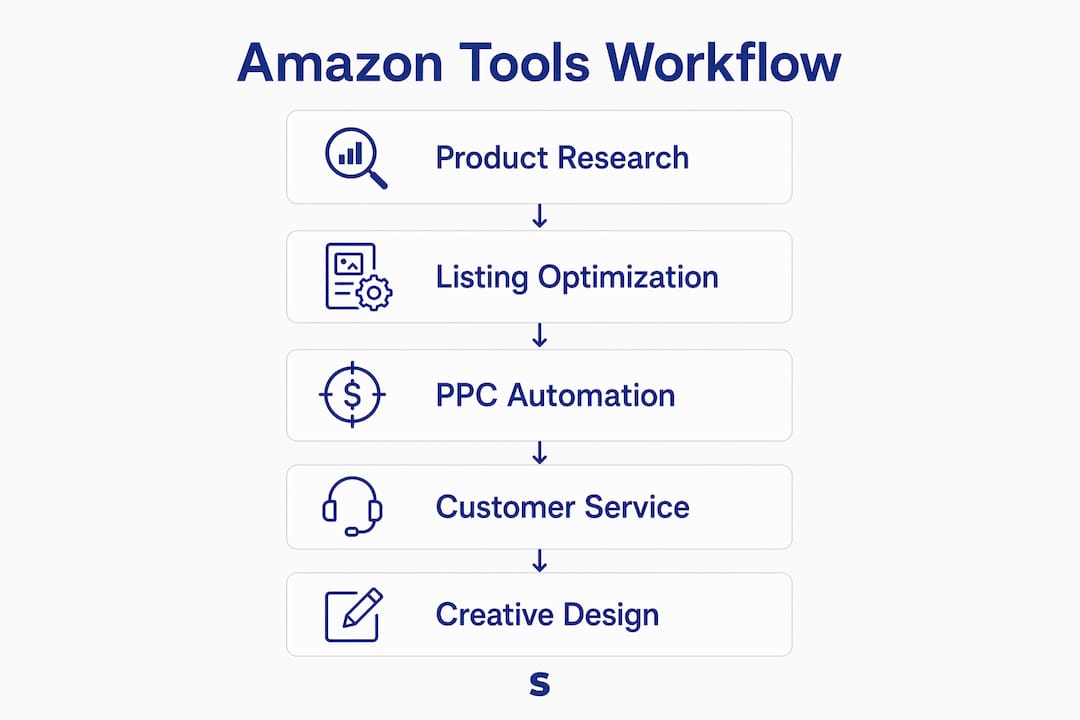
VistaCreate sits in a category of its own: it handles the creative work. Listing images and promotional graphics are often the last thing sellers invest in, yet they directly affect conversion rates.
How to choose the right Amazon automation tools for your business
Choosing the wrong tool wastes both money and setup time. These criteria cut through the noise:
- Business size and budget: Free tools like the Amazon Seller app cover the basics for new sellers. Established sellers with real ad spend need tools that justify their subscription cost through measurable returns.
- Integration with Seller Central: Any third-party tool connecting to your account should use Amazon’s official OAuth authorization via the Selling Partner API. Tools that ask for your Seller Central password or MFA codes are a security risk, full stop.
- Feature set vs. complexity: An all-in-one platform like Helium 10 or ZonGuru covers more ground but takes longer to learn. Specialized tools like FeedbackWhiz or InventoryLab do fewer things but do them well.
- Pricing model: Per-seat subscriptions, percentage-of-ad-spend models, and flat monthly fees all carry different risk profiles depending on your volume. A percentage-of-spend model is fine at $5,000/month in ads; it gets painful at $50,000.
- Vendor trustworthiness: Check whether the tool is listed in Amazon’s Selling Partner Appstore. That vetting process is not perfect, but it filters out the worst actors.
Clean data is the foundation that makes automation work. Accurate cost of goods sold (COGS), correct shipping lead times, and realistic profit margins must be in the system before you turn anything on. Garbage inputs produce garbage automated decisions, and those decisions compound fast when a repricing rule or a bid adjustment runs 24/7.
Pro Tip: Set your business rules thoroughly the first time. Practitioners who configure detailed parameters upfront and leave them alone consistently outperform those who make constant manual overrides. Frequent tweaks confuse the algorithm and make it harder to isolate what actually changed performance.
Sophisticated sellers increasingly prefer “action-first” automation: the tool drafts a recommended change (a bid adjustment, a restock order, a keyword addition), and the seller approves it with one click before it goes live. This keeps the speed of automation without surrendering control over decisions that are hard to reverse.
How AI-powered tools handle Amazon PPC optimization
AI-driven PPC tools do something manual campaign management cannot: they analyze every campaign simultaneously, flag where ad spend is producing no return, and recommend specific changes with the data to back each one.

Selloop takes this a step further with a 21-day tracking window. After a bid change or keyword action is approved, Selloop monitors the result over three weeks and shows whether the change actually worked. That feedback loop is what most PPC tools skip entirely: they make the change and move on, leaving sellers to figure out the impact themselves.
Automated keyword harvesting pulls converting search terms from your campaigns and promotes them to targeted keywords. Negative keyword identification catches terms that spend without converting and blocks them before they drain more budget. Both tasks are tedious to do manually across more than a handful of campaigns, and both compound in value the longer they run.
The risk with fully autonomous “black box” PPC automation is over-optimization: the algorithm chases a metric (ACoS, for example) so aggressively that it kills spend on keywords that were building long-term rank. Action-first tools avoid this by keeping a human in the loop on every material change. Selloop’s campaign health scoring gives sellers a single number that reflects overall campaign condition, so they know where to focus attention without digging through raw data.
For sellers asking whether the PPC investment is worth it at all, the 2026 PPC analysis from Selloop’s team covers the current cost-per-click environment and where automation changes the math.
How these tools were evaluated
The tools featured here were assessed across five dimensions: feature depth within their stated category, pricing transparency, integration with Amazon’s official APIs, user-reported reliability, and the quality of data they surface for decision-making.
Tools that connect through Amazon’s Selling Partner API with read-only access and official OAuth authorization scored higher on security grounds. Any platform requiring direct credential sharing was excluded from serious consideration. Pricing models were evaluated for predictability: flat monthly fees score better for sellers who want cost certainty, while percentage-of-spend models were noted where they apply.
User feedback from G2 and similar platforms informed the reputation assessment, but review volume alone was never the deciding factor. A tool with fewer reviews and a clear, verifiable feature set outranks a heavily reviewed tool with vague differentiation. The goal was to identify what each tool actually does well, not which one has the most vocal user base.
Pricing considerations for Amazon automation tools
Pricing structures across this category vary more than most sellers expect. The Amazon Seller app is free. Native tools like Automate Pricing and Veeqo carry no additional subscription cost beyond your selling plan. That baseline covers repricing, mobile management, and basic shipping automation without spending a dollar on third-party software.
Third-party platforms start around $30–$50 per month for entry-level plans and scale into the hundreds for full-featured tiers. All-in-one suites like Helium 10 bundle many tools under one subscription, which looks expensive until you price out the individual tools separately. Specialized platforms like FeedbackWhiz or InventoryLab cost less per month but cover a narrower slice of the workflow.
PPC-specific tools priced on a percentage of ad spend deserve particular scrutiny. At low ad budgets, the percentage fee is manageable. At higher spend levels, a flat-fee alternative often delivers better economics. Sellers running more than $10,000 per month in ads should model both pricing structures before committing.
Free trials are standard across most platforms. Use them to test the actual interface, not just the feature list. A tool that takes three hours to set up and requires a manual every time you change a setting will not get used consistently, regardless of how capable it is on paper.
Selloop is the affordable PPC alternative for sellers who are done guessing
Most enterprise PPC tools are built for agencies managing dozens of accounts. Selloop is built for the seller who needs the same analytical depth without paying agency prices or navigating a platform designed for someone else.
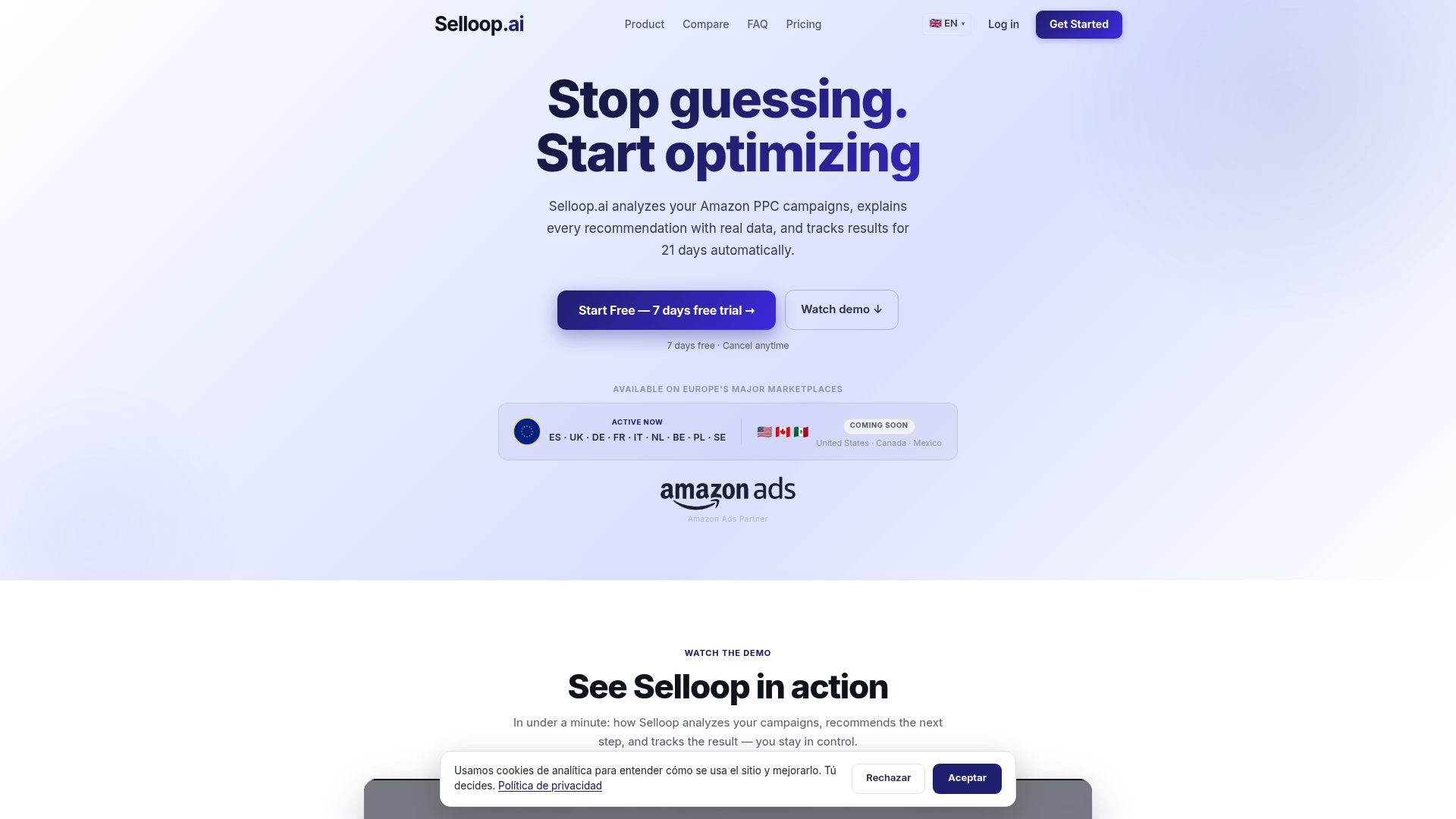
Selloop analyzes your Sponsored Products and Sponsored Brands campaigns, identifies where budget is being wasted, and delivers specific, data-backed recommendations: which bids to raise, which keywords to harvest, which search terms to negate. You approve each change with one click. Selloop applies it and tracks the result over 21 days, so you know whether it worked. No spreadsheets, no PPC degree required.
Plans start with a low monthly fee and a free trial period. For sellers who want AI-powered PPC management without the enterprise price tag, Selloop is the practical next step. You can also explore the 2026 ad optimization guide for a deeper look at how AI changes the PPC math for US sellers.
Key Takeaways
The most effective Amazon seller automation strategy combines a free native toolset for core operations with one or two specialized third-party platforms matched to your biggest workflow bottleneck.
| Point | Details |
|---|---|
| Start with Amazon’s free tools | The Amazon Seller app, Automate Pricing, and Veeqo cover repricing, mobile management, and shipping at zero cost. |
| Match tools to your workflow gap | Product research, PPC, inventory, and analytics each have specialized leaders; no single tool wins every category. |
| Clean data before automating | Accurate COGS, lead times, and margins must be set correctly before any automation runs reliably. |
| Prefer action-first PPC tools | Tools that draft changes for human approval reduce the risk of irreversible over-optimization. |
| Selloop for affordable PPC AI | Selloop tracks bid changes over 21 days and offers a low monthly fee with a free trial, making AI-driven PPC accessible without enterprise pricing. |