Campaign Health Score on Amazon: Your 2026 Guide
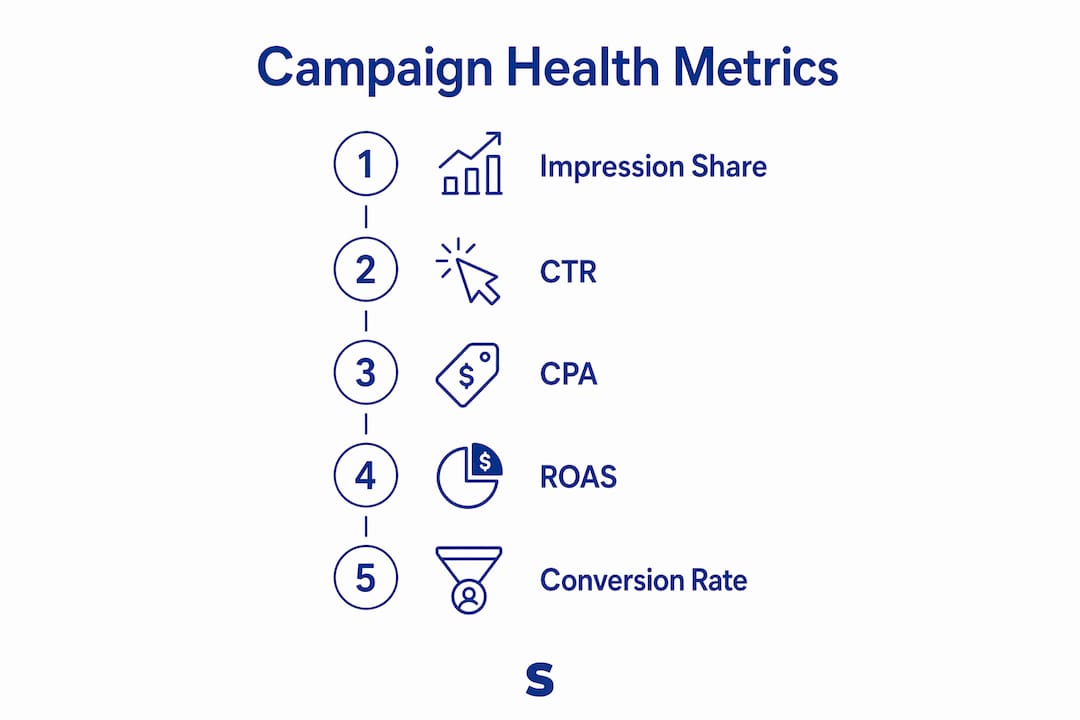
A campaign health score on Amazon is a composite metric that measures how well your ad campaigns perform across key indicators like conversion rate, cost efficiency, and policy compliance. Sellers who track this score gain a clear picture of where their ad spend works and where it bleeds. The score draws from metrics including impression share, click-through rate (CTR), cost per acquisition (CPA), and return on ad spend (ROAS). Campaigns rated as Healthy, Needs Attention, or Critical reflect how far each metric sits from its target benchmark. Monitoring this score is the fastest way to protect ad eligibility and keep revenue growing.
What metrics make up the campaign health score on Amazon?
Campaign health is built from several core metrics, each measuring a different dimension of ad performance. No single number tells the full story. Together, they form a picture of whether a campaign is earning its budget or wasting it.
Impression share measures how often your ad appears when it is eligible to show. A healthy impression share sits above 60%. Falling below that threshold signals budget constraints, low bids, or poor relevance scores.

CTR shows how compelling your ad is to shoppers who see it. A low CTR often points to weak creative, mismatched keywords, or poor product images. CTR alone is a vanity metric, but a sudden drop is a reliable early warning sign.
CPA and ROAS are the profitability anchors. CPA tells you what each conversion costs. ROAS tells you how much revenue each dollar of ad spend generates. These two metrics determine whether a campaign is worth running at its current budget.
Conversion rate ties everything together. A campaign can have strong CTR and low CPA only if the product page converts. Category benchmarks vary, but any sustained drop in conversion rate signals a listing problem, not a bidding problem.
Pro Tip: Before adjusting bids, check whether your campaign health issues trace back to conversion rate. A bid change cannot fix a broken product page.
Statistical reliability matters here. Reliable CTR analysis requires at least 100 clicks per variant. CPA tests need at least 30 conversions to reach statistical confidence. Acting on smaller samples produces false conclusions and wasted spend.
| Metric | Benchmark | Health Signal |
|---|---|---|
| Impression share | Above 60% | Below 60% signals budget or relevance issues |
| CTR | Category dependent | Sudden drops indicate creative or keyword mismatch |
| CPA | At or below target CPA | Above target signals conversion or bid problem |
| ROAS | At or above break-even ROAS | Below break-even means the campaign loses money |
| Conversion rate | Category dependent | Drops point to listing quality, not bids |
Campaign structure also shapes health scores. Mixing broad, phrase, and exact match types in one ad group makes it impossible to diagnose which keywords drive results. Separating match types and running regular keyword harvesting keeps the data clean and the score meaningful.
How does Amazon’s Account Health Rating affect your campaigns?
The Amazon Account Health Rating (AHR) is a numeric score from 0 to 1,000, updated in near real time. It measures your compliance with Amazon’s selling policies across your entire account. The AHR directly controls your ad eligibility, which makes it inseparable from campaign performance analysis.
The AHR scoring thresholds break down as follows:
- 200 or above: Healthy. Full ad eligibility maintained.
- 100–199: At Risk. Amazon may throttle ad impressions across your catalog.
- 99 or below: Critical. Immediate deactivation eligibility triggered.
The throttling behavior at the At Risk level is the detail most sellers miss. Unresolved account warnings suppress ad impressions across the entire catalog, not just on flagged products. A seller can run a perfectly structured Sponsored Products campaign and still see impression volume collapse because of an unresolved policy notice on a different ASIN.
Fixing bids on a campaign while ignoring an At Risk AHR is like adjusting the sails on a boat with a hole in the hull. The account-level problem overrides everything at the campaign level.
Policy violations compound quickly under 2026 rules. A single unresolved IP complaint carries roughly the same weight as three late shipment violations. Competitive abuse through false IP complaints is a real tactic in crowded categories. Sellers must monitor the Account Health dashboard daily, not weekly.
Pro Tip: Audit your AHR before touching campaign bids. If your score sits below 200, resolving account issues will recover more impression volume than any bid adjustment.
How to perform a thorough campaign health check
A proper Amazon ads audit follows a specific sequence. Skipping steps or starting with bids produces misleading results. The 7-stage audit method takes roughly 4–5 hours and covers the full stack from listing to bid.
- Listing health. Check title, bullet points, images, A+ content, and backend keywords. A listing that does not convert makes every ad dollar less effective.
- Review velocity and rating. Products with fewer than 15 reviews or a rating below 3.8 stars convert poorly regardless of ad placement. Fix this before scaling spend.
- Campaign structure. Separate broad, phrase, and exact match types into distinct ad groups. This isolates performance data and makes optimization decisions cleaner.
- ACOS and TACOS. Advertising Cost of Sale (ACOS) measures ad spend against ad revenue. Total ACOS (TACOS) measures ad spend against total revenue, including organic. A campaign breaking even on ACOS may still be profitable if it drives organic rank gains.
- Keyword harvesting. Pull search term reports weekly. Move high-converting search terms from broad campaigns into exact match campaigns. Add non-converting terms as negatives.
- Brand defense. Run Sponsored Brand campaigns on your own brand keywords. Competitors bid on your brand terms. Defending them protects conversion rate and lowers overall CPA.
- Bid optimization. Adjust bids last, after all structural and listing issues are resolved. Bid changes cannot fix a product page that does not convert.
Pro Tip: Run a full audit quarterly. Monthly maintenance reviews should focus on search term reports and budget pacing. Reserve structural changes for the quarterly cycle.
The ACOS versus TACOS distinction matters more than most sellers realize. A new product launch with high ACOS may be building organic rank that pays off over 60–90 days. Cutting spend too early based on ACOS alone kills that compounding benefit.
Common mistakes sellers make when reading campaign health scores
The most expensive mistake in Amazon campaign performance analysis is confusing the Account Health Rating with the campaign health score. They measure different things. Misattributing AHR problems to campaign structure sends sellers chasing bid changes that cannot solve an account-level compliance issue.
A campaign health score reflects execution quality. An Account Health Rating reflects policy compliance. Both must be healthy for ads to perform. Treating them as the same metric wastes time and money.
The second major mistake is optimizing for vanity metrics. CTR and impression volume look good in reports. They do not pay bills. Prioritize wasted spend on zero-conversion keywords before scaling campaigns with strong ROAS. Pausing non-converting keywords recovers budget faster than any bid increase on winning campaigns.
Other common pitfalls sellers encounter:
- Chasing low ACOS without checking TACOS. A 10% ACOS on a campaign that suppresses organic rank is not a win.
- Ignoring policy violation timelines. Unresolved notices age into heavier penalties. A notice ignored for 30 days costs more AHR points than one resolved in 48 hours.
- Scaling winners before fixing losers. Doubling budget on a high-ROAS campaign while bleeding spend on zero-conversion keywords produces a net loss.
- Acting on insufficient data. Pausing a keyword after 20 clicks is statistically meaningless. Wait for the minimum sample size of 100 clicks before making CTR-based decisions.
The campaign health score is only as useful as the decisions it drives. Sellers who treat it as a dashboard decoration rather than a decision trigger leave money on the table every week.
Key Takeaways
A campaign health score on Amazon requires both campaign-level metric discipline and account-level compliance to deliver consistent ad performance.
| Point | Details |
|---|---|
| Health score components | Impression share, CTR, CPA, ROAS, and conversion rate each signal a different performance problem. |
| AHR threshold awareness | An AHR below 200 suppresses impressions catalog-wide, overriding even well-structured campaigns. |
| Audit sequence matters | Fix listing health and reviews before adjusting bids; structural problems block bid-level gains. |
| Data sample minimums | Use at least 100 clicks per variant for CTR tests and 30 conversions for CPA decisions. |
| Wasted spend first | Pause zero-conversion keywords before scaling winners to recover budget and improve net profitability. |
What sellers consistently get wrong about campaign health
Working with Amazon PPC data across hundreds of campaigns, one pattern stands out above all others: sellers reach for bid changes the moment performance dips. It feels productive. It rarely works.
The real leverage sits upstream. A product with 8 reviews and a 3.6-star rating will not convert at any bid level. An account with an At Risk AHR will not serve full impression volume no matter how high the bids go. The campaign health score reflects the output of decisions made weeks earlier, not the bid you set this morning.
The sellers who sustain strong ad performance share one habit: they treat the campaign health check as a weekly ritual, not a crisis response. They review search term reports before touching bids. They check the Account Health dashboard before scaling spend. They know their break-even ROAS and use it as a hard floor, not a suggestion.
Amazon’s 2026 policy updates have made account health more consequential than ever. IP complaints and policy violations now compound faster and carry heavier score penalties. Sellers who ignore the AHR until it hits Critical status face a recovery process that takes weeks, not hours. Daily monitoring is no longer optional for serious sellers.
The most underrated move in campaign management is cutting wasted spend on non-converting keywords. That recovered budget, redeployed into proven performers, compounds into meaningful profit gains over a quarter. No bid algorithm replaces that discipline.
— Selloop
How Selloop helps you maintain a healthy campaign score
Managing campaign health across multiple Amazon ad accounts is time-consuming when done manually. Selloop’s AI-powered PPC management analyzes your campaigns continuously, flags metrics that deviate from target benchmarks, and surfaces the specific changes that will recover performance fastest.
Selloop tracks the impact of every change over a 21-day window, so you see exactly what each bid adjustment, keyword pause, or budget shift produced. No spreadsheets. No guesswork about whether a change worked. Sellers using Selloop report converting wasted ad spend into measurable profit gains without spending hours inside campaign dashboards. If you want cleaner data and faster decisions on your Amazon ad performance metrics, start with Selloop and let the AI surface what needs attention first.
FAQ
What is a campaign health score on Amazon?
A campaign health score is a composite metric that rates how well an Amazon ad campaign performs across impression share, CTR, CPA, ROAS, and conversion rate. Campaigns are typically categorized as Healthy, Needs Attention, or Critical based on how far each metric sits from its target benchmark.
How does the Account Health Rating affect my ad campaigns?
An AHR below 200 signals At Risk status, which causes Amazon to throttle ad impressions across your entire catalog. Fixing account-level policy violations recovers impression volume faster than any campaign-level bid adjustment.
What sample size do I need for reliable campaign analysis?
CTR tests require at least 100 clicks per variant to reach statistical reliability. CPA evaluations need at least 30 conversions before a decision is statistically sound.
Should I fix my listing before adjusting bids?
Yes. Listing health and review velocity determine your conversion rate. Aggressive bid changes produce no improvement if the product page does not convert shoppers who click the ad.
What is the difference between ACOS and TACOS?
ACOS measures ad spend against ad-attributed revenue only. TACOS measures ad spend against total revenue, including organic sales. A high ACOS campaign may still be profitable if it is building organic rank and lifting total revenue.