Best Amazon PPC Software Alternatives for Sellers in 2026
Which Amazon PPC software alternatives should you consider in 2026?
The short answer: it depends on your monthly ad spend, how much control you want over bidding decisions, and whether you need a tool that grows with you or one that just gets the job done today.
The table below cuts through the noise. These are the tools that consistently appear at the top of seller discussions in 2026, each with a distinct reason to exist.

| Tool | Best For | Key Feature | Starting Price | Automation Level | Scalability | Reporting |
|---|---|---|---|---|---|---|
| Selloop.ai | SMB sellers wanting AI clarity | 21-day change tracking + one-click approvals | €29/month | AI-driven | Small to mid-size | Campaign health scoring, smart alerts |
| Helium 10 Ads | All-in-one seller toolkit users | Combined keyword research + PPC automation | — | AI + rule-based | Small to large | Keyword and campaign dashboards |
| Perpetua | High-spend automated bidding | Goal-based bid optimization across ad types | — | AI-driven | Mid to enterprise | Multi-ad-type reporting |
| Teikametrics Flywheel | Data-driven mid-market sellers | Flat monthly fees | Custom | AI + rule-based | Mid to large | Profitability and bid analytics |
| Pacvue | Agencies and enterprise brands | Amazon Marketing Cloud integration | Custom | AI-driven | Enterprise | Multi-market, team collaboration |
| Quartile | Large brands, multi-channel | Cross-channel bid optimization | Custom | AI-driven | Enterprise | Cross-channel dashboards |
| PPC Entourage | Search term analysis depth | Granular search term reporting | €29/month | Rule-based | Small to mid | Search term and ASIN reports |
| Prism | Agencies managing multiple accounts | Multi-account campaign management | Not publicly listed | Rule-based + AI | Agency-scale | Custom reporting |
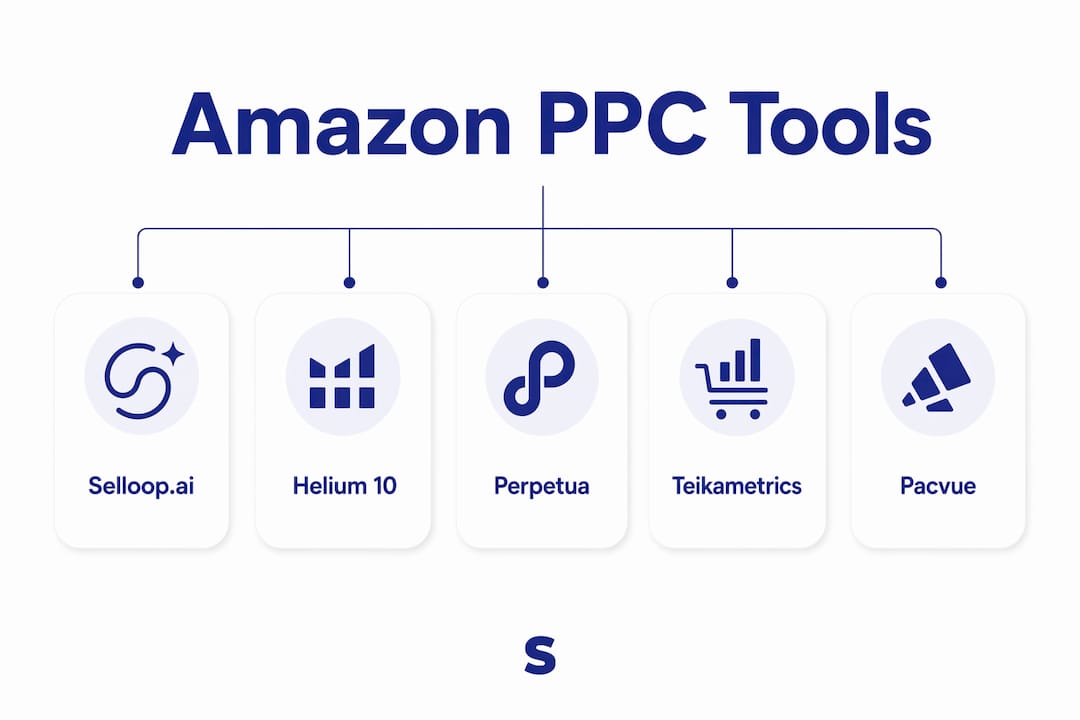
Trial availability varies significantly across these platforms. Selloop.ai offers a 7-day free trial with no credit card required. Helium 10 provides tiered demos. Enterprise tools like Pacvue and Quartile typically require a custom demo before pricing is disclosed. Free trials reduce risk and are worth prioritizing when evaluating any new platform.
Table of Contents
- A closer look at the leading Amazon PPC tools
- How to choose the best Amazon PPC software for your business
- Understanding automation in Amazon PPC management
- What makes Selloop.ai different from other PPC tools
- What sellers actually say about these tools
- Selloop gives you AI-level PPC analysis without the enterprise price tag
- Key Takeaways
A closer look at the leading Amazon PPC tools
Selloop.ai

Selloop.ai takes a different approach than most tools on this list. Rather than handing you a dashboard full of charts and leaving you to figure out what to do, it tells you exactly where your ad budget is leaking and what to fix. The AI analyzes your Sponsored Products and Sponsored Brands campaigns, surfaces the specific bids and keywords that need attention, and gives you a data-backed reason for each recommendation. You approve with one click. Selloop applies the change on Amazon and tracks the result over 21 days.
Strengths:
- Clear, justified recommendations (no guesswork on why a change is suggested)
- 21-day impact tracking confirms whether changes actually worked
- Automated keyword harvesting and negative keyword suggestions
- Campaign health scoring with customizable AI profiles (conservative, balanced, aggressive)
- Plans start at an affordable monthly rate, making it accessible for smaller sellers
Limitations:
- Primarily focused on Sponsored Products and Sponsored Brands (not DSP)
- Built for individual sellers and small agencies, not enterprise multi-market operations
Helium 10 Ads (Adtomic)
Helium 10 merged with Pacvue and now offers its PPC automation under the Adtomic brand within the broader Helium 10 suite. If you already use Helium 10 for keyword research, rank tracking, or product research, adding Adtomic is a natural extension. The entry-level plan starts at $99/month, with the Platinum plan at $129/month and Diamond at $359/month for heavier users.
Strengths:
- Deep integration with Helium 10’s keyword and product research tools
- Both AI and rule-based automation available
- Strong documentation and community support
Limitations:
- PPC features feel secondary to the broader toolkit
- Pricing jumps significantly between tiers
Perpetua
Perpetua is built for sellers who want to set a goal and let the software handle execution. It offers a base pricing tier suitable for brands with lower ad spend, with additional charges applying at higher spending levels. That pricing structure makes it expensive for high-spend brands but straightforward for those within the base tier.
Strengths:
- Goal-based automation across Sponsored Products, Brands, and Display
- Clean interface with strong onboarding support
Limitations:
- Pricing becomes opaque and costly above the base spend threshold
- Less granular control for sellers who want to understand bid logic
Teikametrics Flywheel
Teikametrics charges a transparent pricing model with a flat fee and additional fees at higher spend levels, which may increase costs for high-volume advertisers. Flywheel combines AI bid optimization with rule-based controls, giving sellers more visibility into what the system is doing.
Strengths:
- Transparent pricing model relative to competitors
- Strong profitability analytics
- Good fit for sellers in the $10K–$50K monthly spend range
Limitations:
- Custom pricing requires a sales conversation
- Interface has a steeper learning curve than simpler tools
Pacvue
Pacvue targets agencies and brands with high monthly ad spend. It supports Amazon Marketing Cloud integration, multi-market campaign management, and team collaboration features that smaller tools simply do not offer. Pricing is custom and requires a demo.
Strengths:
- Enterprise-grade reporting and multi-market support
- Deep analytics including DSP and AMC
- Strong account management and support
Limitations:
- Overkill and cost-prohibitive for sellers under $50K/month
- Long onboarding process
Quartile
Quartile focuses on cross-channel bid optimization, including Amazon and other retail media networks, designed for large brands needing unified reporting. Like Pacvue, pricing is custom and enterprise-oriented.
Strengths:
- Cross-channel campaign management
- AI-driven optimization with strong reporting dashboards
Limitations:
- Not designed for single-marketplace sellers
- Minimum spend requirements effectively exclude smaller advertisers
PPC Entourage
PPC Entourage is among the affordable rule-based tools available, offering competitive monthly pricing. Its strength is search term analysis: it surfaces which search terms are driving wasted spend and makes it straightforward to build negative keyword lists. Sellers who want hands-on control without paying enterprise prices often land here.
Strengths:
- Detailed search term and ASIN-level reporting
- Straightforward rule-based automation
- Lower price point with no percentage-of-spend fees
Limitations:
- Rule-based only, no adaptive AI bidding
- Reporting depth does not match enterprise platforms
Prism
Prism is designed for agencies managing multiple Amazon seller accounts. It centralizes campaign management across clients, with custom reporting and multi-account dashboards. Pricing is not publicly listed, and it requires a direct conversation with their sales team.
Strengths:
- Multi-account management built for agency workflows
- Custom reporting capabilities
Limitations:
- Not suited for individual sellers
- Pricing opacity makes budgeting difficult upfront
| Tool | G2 Rating | Support Channels | Trial/Demo |
|---|---|---|---|
| Selloop.ai | N/A (newer platform) | Email + documentation | 7-day free trial |
| Helium 10 Ads | — | Live chat, email, community | Tiered demos |
| Perpetua | — | Dedicated onboarding | Demo required |
| Teikametrics | — | Email, account manager | Demo required |
| Pacvue | — | Dedicated account manager | Demo required |
| Quartile | — | Account manager | Demo required |
| PPC Entourage | Not listed on G2 | Email, documentation | Free trial available |
| Prism | Not listed on G2 | Direct sales contact | Demo required |
Customer support quality varies from email-only access at entry-level tools to dedicated account managers at enterprise platforms. For sellers new to PPC software, live chat and onboarding assistance make a measurable difference in how quickly the tool delivers results.
How to choose the best Amazon PPC software for your business
The single biggest mistake sellers make is buying for the tool they wish they needed rather than the one their current ad spend actually justifies. Matching software to your business stage saves money and prevents the frustration of paying for features you will never use.
By ad spend level:
- Under $5,000/month: Amazon’s native advertising console is free and handles campaign creation, keyword management, and performance reporting. Paid bid automation rarely pays for itself at this spend level. A lightweight tool like Selloop.ai or PPC Entourage adds structure without breaking the budget.
- $5,000–$50,000/month: This is where dedicated PPC software earns its keep. Tools like Teikametrics Flywheel or Selloop.ai provide the bid optimization and keyword hygiene that manual management cannot sustain at this volume.
- $50,000+/month: Enterprise platforms like Pacvue and Quartile are built for this range. Multi-market support, AMC integration, and team collaboration features become genuinely necessary at this scale.
Key selection criteria:
- Automation type: Do you want AI that adapts dynamically, or rule-based logic you control explicitly? Both have merit. AI is faster to manage; rules give you more visibility.
- Pricing model: Flat monthly fees are predictable. Percentage-of-spend fees scale with your growth, which sounds appealing until you are spending $30K/month and the fee becomes your second-largest ad cost.
- Integration needs: If you rely on inventory management or rank tracking tools, check whether the PPC software connects to them. All-in-one suites like Helium 10 reduce the number of platforms you manage.
- Trial availability: Never commit to a subscription without testing the interface. A tool that looks powerful in a demo can feel clunky in daily use.
- Scalability: Will this tool still work if your ad spend doubles? Some entry-level tools hit a ceiling; others grow with you.
Pro Tip: Before signing up for any paid tool, export 90 days of search term data from your Amazon Advertising console and identify your top 10 wasted-spend terms. This gives you a baseline to measure whether any new software actually moves the needle.
Understanding automation in Amazon PPC management
Automation in Amazon PPC comes in two forms, and confusing them leads to poor tool choices.
Rule-based automation executes bid changes when predefined conditions are met, such as lowering a bid when ACoS exceeds a set threshold. You write the logic; the tool runs it. The upside is transparency: you know exactly why every bid changed. The downside is that rules require constant updating as market conditions shift, and they cannot adapt to signals they were not programmed to recognize.
AI-powered automation works differently. It analyzes historical performance, real-time signals, and patterns across campaigns to adjust bids without explicit rules. The decisions happen faster and at a scale no human can match manually. The tradeoff is less visibility into the reasoning behind each change.
Best practices for using automation effectively:
- Start with conservative automation settings and expand as you build confidence in the tool’s decisions.
- Use automation for repetitive tasks: bid tuning, negative keyword additions, and budget pacing. Keep strategic decisions, like which products to prioritize or how to position a new launch, in human hands.
- Review automation outputs weekly, not monthly. A misconfigured rule or an AI model that has not seen enough data can burn budget quickly.
- Never automate a campaign you do not understand manually first. Automation amplifies both good and bad campaign structure.
The core value of automation is not replacing judgment. It is freeing you from the mechanical work so you can focus on the decisions that actually require a human: product strategy, creative direction, and competitive positioning. AI-driven tools handle bid tuning and keyword hygiene; the rest stays with you.
What makes Selloop.ai different from other PPC tools
Most PPC tools show you data. Selloop.ai tells you what to do with it.
The distinction matters more than it sounds. A dashboard full of ACoS charts and impression graphs is useful only if you know how to interpret it and act on it quickly. Selloop’s AI analyzes your campaigns, identifies where spend is underperforming, and delivers specific recommendations with the data behind each one. You see the reasoning, not just the output.
| Feature | Selloop.ai |
|---|---|
| Recommendation type | AI-generated, data-justified per campaign |
| Change approval | One-click, seller-controlled |
| Impact tracking | 21-day window per change |
| Keyword automation | Harvesting + negative keyword suggestions |
| AI profiles | Conservative, balanced, aggressive |
| Campaign health scoring | Yes |
| Starting price | €29/month |
| Trial | 7-day free trial |
The 21-day tracking window is the feature that separates Selloop from most alternatives. Other tools apply changes and move on. Selloop shows you whether each specific change improved performance, held steady, or hurt results. Over time, that feedback loop builds a clearer picture of what actually works for your catalog.
Selloop is built by Luis Luengo, an Amazon seller with over 10 years of experience across European marketplaces including Spain, the UK, France, Italy, and Germany. That background shapes the tool’s priorities: it focuses on the decisions that actually move profitability for working sellers, not the enterprise reporting features that look impressive in demos but go unused.
What sellers actually say about these tools
User reviews reveal patterns that product pages never mention.
Perpetua earns consistent praise on G2 for its onboarding experience and goal-based automation, but sellers managing tighter budgets frequently flag the pricing jump above the base spend tier as a pain point. The tool works well when you stay within the Essentials plan; the cost structure becomes harder to justify once percentage-of-spend fees kick in.
Teikametrics Flywheel reviews on G2 highlight strong profitability analytics and transparent pricing as genuine differentiators. Criticism tends to focus on the interface complexity and the time required to get the AI model calibrated to a specific catalog. Sellers with straightforward catalogs get results faster than those with large, varied product lines.
Pacvue reviews consistently mention the quality of dedicated account management as a reason sellers stay. The tool itself is powerful, but many users note that the account manager relationship is what makes the investment worthwhile. Without that support layer, the platform’s depth becomes a liability.
Helium 10’s Adtomic receives solid marks from sellers already embedded in the Helium 10 ecosystem. The recurring theme in critical reviews is that the PPC features feel like an add-on to the keyword and research tools rather than a standalone strength.
Quartile reviews on G2 reflect its enterprise positioning: strong scores from large brands managing cross-channel campaigns, with smaller sellers noting the minimum spend requirements effectively put it out of reach.
The pattern across all these reviews is consistent: the best tool is the one that matches your actual business size and workflow. Overpaying for enterprise features you cannot use is as costly as under-tooling a large catalog with a basic rule-set.
Selloop gives you AI-level PPC analysis without the enterprise price tag
Most sellers evaluating Amazon PPC software alternatives are looking for the same thing: less time spent on bid management, fewer wasted ad dollars, and a clearer picture of what is actually working. The tools at the top of the market deliver that, but often at a price that only makes sense for brands spending $50,000 or more per month.
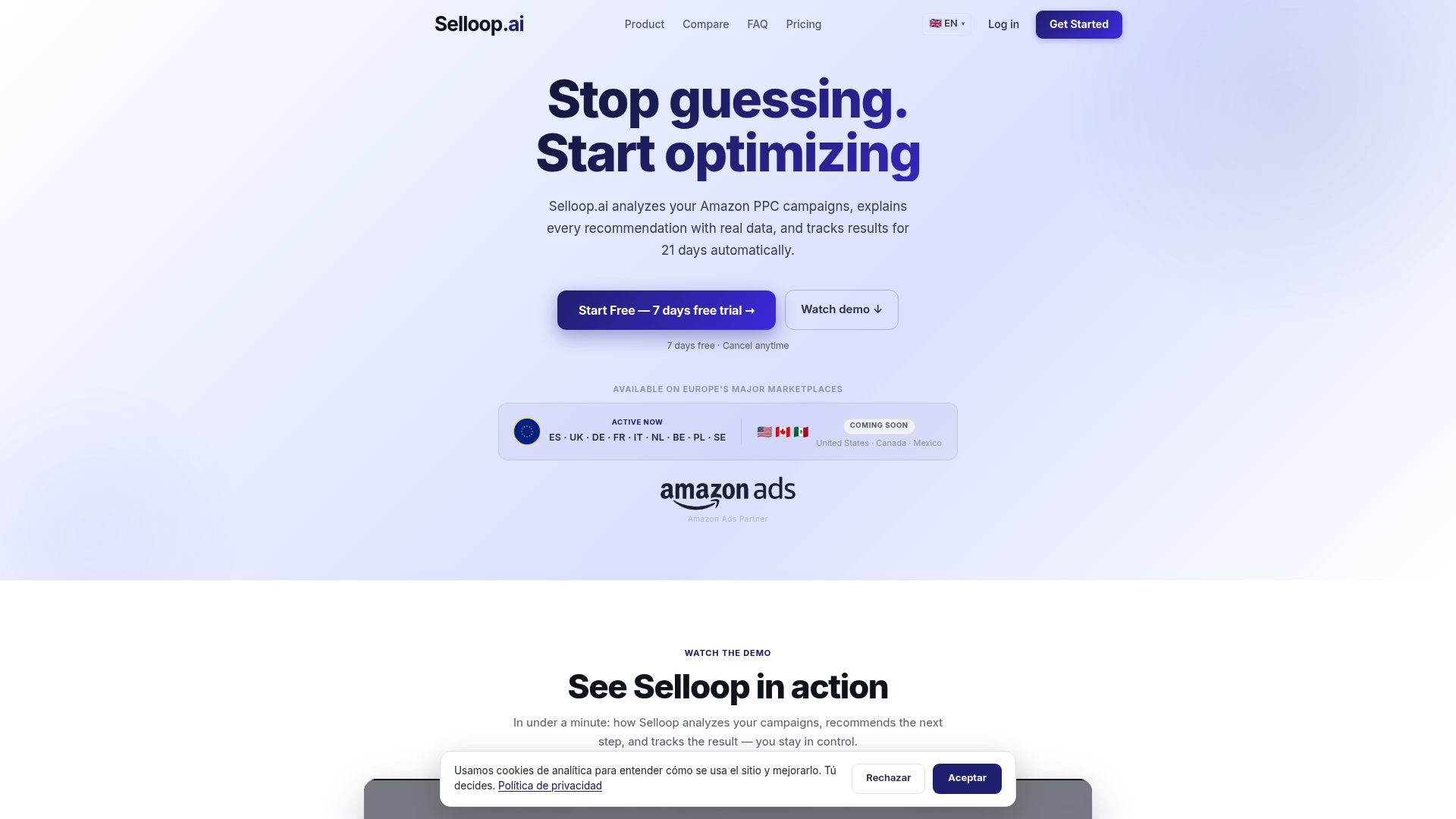
Selloop.ai was built for the seller who does not have that budget but still needs real AI analysis, not just a dashboard. Plans begin at a modest monthly rate, there is no percentage-of-spend fee that scales against you, and the 7-day free trial requires no credit card. The AI analyzes your campaigns, surfaces the specific changes worth making, and tracks whether each one worked over 21 days. You stay in control of every decision.
If you are spending between $1,000 and $50,000 per month on Amazon ads and want to know exactly where that budget is going, try Selloop.ai free and see the recommendations for your own campaigns within minutes of connecting your account.
Key Takeaways
The right Amazon PPC software alternative comes down to your ad spend level, your need for automation transparency, and whether the pricing model stays predictable as you grow.
| Point | Details |
|---|---|
| Match tool to ad spend | Under $5K/month, native Amazon tools often suffice; dedicated software earns its cost above that threshold. |
| Pricing model matters | Flat monthly fees stay predictable; percentage-of-spend fees compound quickly for high-volume advertisers. |
| AI vs. rule-based automation | AI adapts faster; rule-based gives more visibility. Choose based on how much control you need over bid logic. |
| Enterprise tools have minimums | Pacvue and Quartile target $50K+/month spenders; smaller sellers pay for features they will never use. |
| Selloop.ai for SMB sellers | Starts at €29/month with a 7-day free trial, AI-driven recommendations, and 21-day impact tracking per change. |