Best Amazon PPC AI Software for 2026: 20 Tools Compared
The best Amazon PPC AI software in 2026 cuts manual bid management significantly, and top tools can reduce ACoS substantially while scaling ad spend faster than manual management. The field has matured fast. You’re no longer choosing between “automation or not” — you’re choosing between rule-based systems that react to problems and AI-driven platforms that predict them before performance drops.
Here’s the short version for sellers who need a fast answer:
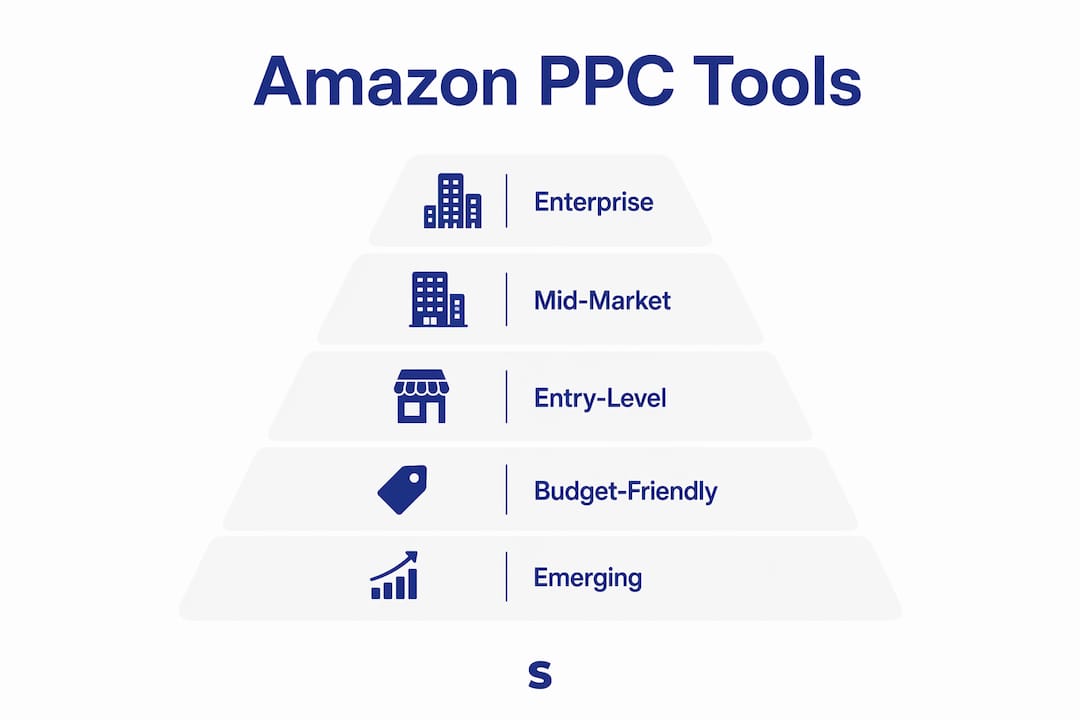
- Beginners and small sellers: Jungle Scout, AdBadger, or Helium 10 / Adtomic
- Growing brands ($10K–$50K/month ad spend): SellerApp, Adbrew, Sellozo, or Atom11
- Mid-market sellers: BidX, Scale Insights, Teikametrics, or Sellerboard
- Enterprise and agencies: Pacvue, Perpetua, Quartile, Sellics, or Skai
- Budget-conscious SMBs who want AI without the enterprise price tag: Selloop
The table below maps every major platform to its best-fit seller type, pricing tier, and core automation approach.
| Tool | Best For | Pricing | Core Features | Automation Level | Keyword Research |
|---|---|---|---|---|---|
| Helium 10 / Adtomic | Beginners to mid-level | From $49/mo (suite) | Bid rules, keyword research, listing tools | Rule-based | Strong (Cerebro, Magnet) |
| SellerApp | SMBs, keyword-focused | Tiered plans | AI keyword intel, PPC dashboard | AI-assisted | Strong |
| Jungle Scout | New sellers | From ~$49/mo | PPC automation, market research | Rule-based | Moderate |
| Adbrew | Growing sellers | Tiered by spend | Budget reallocation, automation | AI-assisted | Moderate |
| Quartile | Large sellers, agencies | Custom (enterprise) | Multi-marketplace, advanced reporting | Full AI | Moderate |
| BidX | Mid to enterprise | Tiered by spend | Profit-margin bidding, granular control | AI-driven | Moderate |
| Sellerboard | Profit-focused sellers | From $149/mo | Profit dashboard, keyword harvesting | Rule-based | Good |
| Pacvue | Enterprise, retail media | Custom (enterprise) | Full-funnel, DSP, retail media | Full AI | Strong |
| Perpetua | Enterprise, multi-brand | Custom (enterprise) | ML bidding, profit optimization | Full AI | Moderate |
| Sellics | Enterprise ($100K+ spend) | Custom | Profit-based bidding, reporting | Full AI | Strong |
| Xneeti | Analytics-first sellers | Tiered plans | Sales analytics, PPC integration | AI-assisted | Moderate |
| Teikametrics | Growth-focused sellers | Tiered by spend | AI bid algorithms, flywheel model | Full AI | Strong |
| Sellozo | Mid-size sellers | Tiered plans | Bid automation, keyword harvesting | AI-assisted | Good |
| SalesDuo | Easy-to-use automation | Tiered plans | Keyword intel, bid recommendations | AI-assisted | Good |
| Skai | Agencies, multi-channel | Custom (enterprise) | Cross-channel AI, Amazon + other platforms | Full AI | Moderate |
| Atom11 | Growing sellers | Tiered plans | Automation, analytics, performance monitoring | AI-assisted | Moderate |
| AdBadger | Beginners, SMBs | From ~$149/mo | Simple automation rules, keyword harvesting | Rule-based | Good |
| Scale Insights | Mid to large sellers | Tiered by spend | Advanced AI bidding, deep analytics | Full AI | Strong |
| AdLabs | Large sellers, agencies | Custom | Enterprise automation, bid and budget control | Full AI | Strong |
| Selloop | SMBs, budget-conscious sellers | From €29/mo | 21-day tracking, smart alerts, data-backed recs | AI-driven | Good |

What separates the best Amazon PPC AI tools from the rest?
The single biggest differentiator is how the AI makes bidding decisions. Rule-based systems work on simple if/then logic: if ACoS exceeds 30%, cut the bid by 10%. That’s reactive. Advanced AI bidding considers dozens of variables simultaneously — time of day, competitor activity, conversion velocity, seasonal patterns — and adjusts bids before performance degrades, not after. That gap in sophistication is what separates a $49/month beginner tool from a $500+/month enterprise platform.

Amazon’s own Ads Agent represents a new benchmark here. It’s a native agentic AI inside the Amazon Ads console that automates pacing across hundreds of campaigns, generates SQL queries for advanced analytics, and reviews tens of thousands of audience segments to find the best-performing selections. In beta testing, 65% of advertisers saw delivery improvements, with an average 18% lower CPM and 16% lower CPA. Third-party tools now have to justify their cost against a free, natively integrated alternative.
Integration depth matters just as much as the AI itself. Tools that connect directly to Amazon Seller Central and pull real-time data can act on performance signals within minutes. Platforms that rely on daily data exports are always one step behind. For sellers running Sponsored Products and Sponsored Brands simultaneously across multiple ASINs, that lag compounds quickly.
How the major platforms break down
Pacvue and Skai sit at the top of the enterprise tier. Pacvue covers the full advertising funnel, including DSP and retail media, making it the go-to for brands that advertise beyond Sponsored Products. Skai extends that logic across channels, managing Amazon alongside Google and Meta from a single interface. Both require custom pricing and dedicated onboarding, which means they’re built for teams with a dedicated ad operations function.
Perpetua and Sellics (now part of the same ecosystem) use machine learning to optimize bids based on profit margins rather than ACoS alone. That distinction matters for sellers managing multiple brands with different margin profiles. Sellics is specifically positioned for sellers running $100K+ in monthly ad spend, where the cost of suboptimal bidding at scale justifies the platform fee.
Teikametrics and Scale Insights occupy a strong mid-to-enterprise position. Teikametrics uses a flywheel model that factors in organic rank and ad performance together, which is genuinely different from pure ACoS optimization. Scale Insights leans heavily on machine learning for bid sophistication and suits sellers who want deep analytics without the full enterprise overhead of Pacvue.
BidX focuses specifically on profit-margin-based bid optimization with granular keyword-level control. It’s a strong fit for mid-market sellers who’ve outgrown rule-based tools but don’t need the full retail media stack that Pacvue offers.
Helium 10 / Adtomic remains the most popular entry point for sellers already inside the Helium 10 ecosystem. The automation is rule-based rather than AI-driven, but the integration with Cerebro and Magnet for keyword research is genuinely useful. Sellers who want to graduate from manual management without switching their entire toolset often start here.
Adbrew stands out for its focus on budget reallocation efficiency. Rather than just adjusting individual bids, it identifies which campaigns are burning budget without returns and shifts spend toward higher-performing placements. That’s a meaningful capability for sellers managing 20+ campaigns simultaneously.
Quartile handles multi-marketplace complexity well, making it a practical choice for agencies managing portfolios across Amazon US, UK, and EU simultaneously. Its reporting depth is one of the strongest in the field for that use case.
SellerApp combines AI-enhanced keyword intelligence with PPC management in a way that’s accessible to SMBs. It’s not the most sophisticated AI bidder, but its keyword analysis tools are genuinely strong, and the dashboard is readable without a training course.
Sellozo and SalesDuo both target mid-size sellers who want cleaner automation without the complexity of enterprise platforms. Sellozo’s bid automation is straightforward; SalesDuo adds keyword intelligence and easy-to-read bid recommendations on top of that foundation.
Sellerboard is worth calling out separately because it combines a profit dashboard with PPC management in a way most tools don’t. You can see the actual margin impact of your ad spend in real time, not just ACoS. For sellers who think in terms of net profit rather than advertising metrics, that framing changes how they make decisions.
Xneeti integrates sales analytics with PPC data, which is useful for sellers who want to understand how advertising performance connects to overall sales velocity. It’s a reasonable choice for analytics-first sellers who find pure PPC tools too narrow.
How to choose the right AI-powered Amazon PPC software
The right tool depends on three things: your monthly ad spend, how much time you can spend managing campaigns, and whether you need multi-account or multi-marketplace support. Everything else is secondary.
By seller size and spend
New sellers (under $5K/month ad spend) should start with a tool that has a short learning curve and transparent bid recommendations. Jungle Scout, AdBadger, and Helium 10 / Adtomic all fit that profile. The key for beginners is simplicity: a clean dashboard, clear keyword controls, and enough automation to stop manual bid-checking from eating your week. Avoid enterprise platforms at this stage — the complexity will slow you down more than it helps.
Growing sellers ($10K–$50K/month) need keyword harvesting, negative keyword automation, and more sophisticated bid rules. At this spend level, manual management becomes genuinely impossible to do well. SellerApp, Adbrew, Atom11, and Sellozo are all strong options here. The efficiency gains from automation at this tier free up time for the strategic decisions that actually move the needle.
Established sellers ($50K–$150K/month) need AI-driven optimization, not just rules. Teikametrics, Scale Insights, BidX, and Selloop all operate at this level with varying degrees of AI sophistication. Profit-based bidding becomes critical here — optimizing for ACoS alone can mask margin erosion across a large catalog.
Enterprise sellers ($150K+/month) need platforms that scale across brands, marketplaces, and team members. Pacvue, Perpetua, Quartile, Sellics, and Skai are the realistic options. White-label reporting, API integrations, and dedicated account management are table stakes at this tier.
Key selection criteria
- Automation level: Rule-based tools are predictable but require more manual configuration. AI-driven tools handle complexity automatically but need a learning period.
- Keyword research depth: Tools like Helium 10 / Adtomic, SellerApp, and Teikametrics have strong native keyword research. Others rely on Amazon’s own data.
- Pricing structure: Most tools charge based on managed ad spend, not a flat fee. Confirm whether the pricing scales linearly or jumps at spend thresholds.
- Integration with Seller Central: Direct API integration means faster data and faster bid updates. Confirm the connection method before committing.
- Customer support: For enterprise tools, dedicated account management is worth paying for. For SMB tools, check whether support is chat-only or includes onboarding calls.
- Trial availability: Most platforms offer a free trial or demo. Run one with a real campaign before signing an annual contract.
Pro Tip: Before starting any trial, export your last 90 days of search term data from Seller Central. Load it into the trial platform on day one. You’ll see immediately how the tool handles your actual keyword mix, not a demo dataset.
Additional Amazon PPC AI tools worth considering in 2026
Beyond the main platforms, several tools serve specific needs or emerging seller segments particularly well.
- AdLabs targets large sellers and agencies with enterprise-grade bid and budget automation. Its focus is on complex campaign structures where manual oversight would require a full-time analyst.
- AdBadger keeps things simple by design. Straightforward automation rules, keyword harvesting, and a clean interface make it one of the better choices for sellers who want to automate without a steep learning curve. Pricing starts around $149/month.
- Atom11 balances automation with performance monitoring in a way that suits growing sellers who want data-driven decisions without committing to a full enterprise platform. Its analytics layer is more developed than most tools at its price point.
- SalesDuo pairs keyword intelligence with easy-to-read bid recommendations. The dashboard is one of the more approachable in the mid-market segment, and it suits sellers who want automation without needing to understand every underlying algorithm.
- Xneeti integrates PPC management with broader sales analytics, which is useful for sellers who want to see how ad performance connects to organic sales velocity and overall account health.
These tools work best as part of a broader Amazon PPC strategy that includes regular search term audits, negative keyword management, and campaign health reviews. No tool automates judgment entirely — the best platforms surface the right data and make the right recommendations, but the seller still makes the final call on strategy.
Selloop: the AI Amazon PPC tool built for sellers who can’t justify enterprise pricing
Most AI Amazon PPC tools are built for the enterprise and priced accordingly. Selloop takes the opposite approach. It’s built specifically for small and medium sellers who need real AI-driven optimization without paying $500+ per month for features they’ll never use.
The core of Selloop’s approach is a 21-day performance tracking window. When you approve a bid change or keyword action, Selloop tracks what actually happens over the following three weeks and shows you whether the change worked. That feedback loop is what most tools skip. They make changes and move on; Selloop shows you the result so you can learn from it and build confidence in the recommendations.
Selloop’s data-backed recommendations include keyword harvesting, negative keyword suggestions, bid adjustments, and campaign health scoring. Each recommendation comes with the data that justifies it, so you’re not approving changes blindly. The platform also offers customizable AI optimization profiles — conservative, balanced, or aggressive — so sellers can match the automation intensity to their risk tolerance.
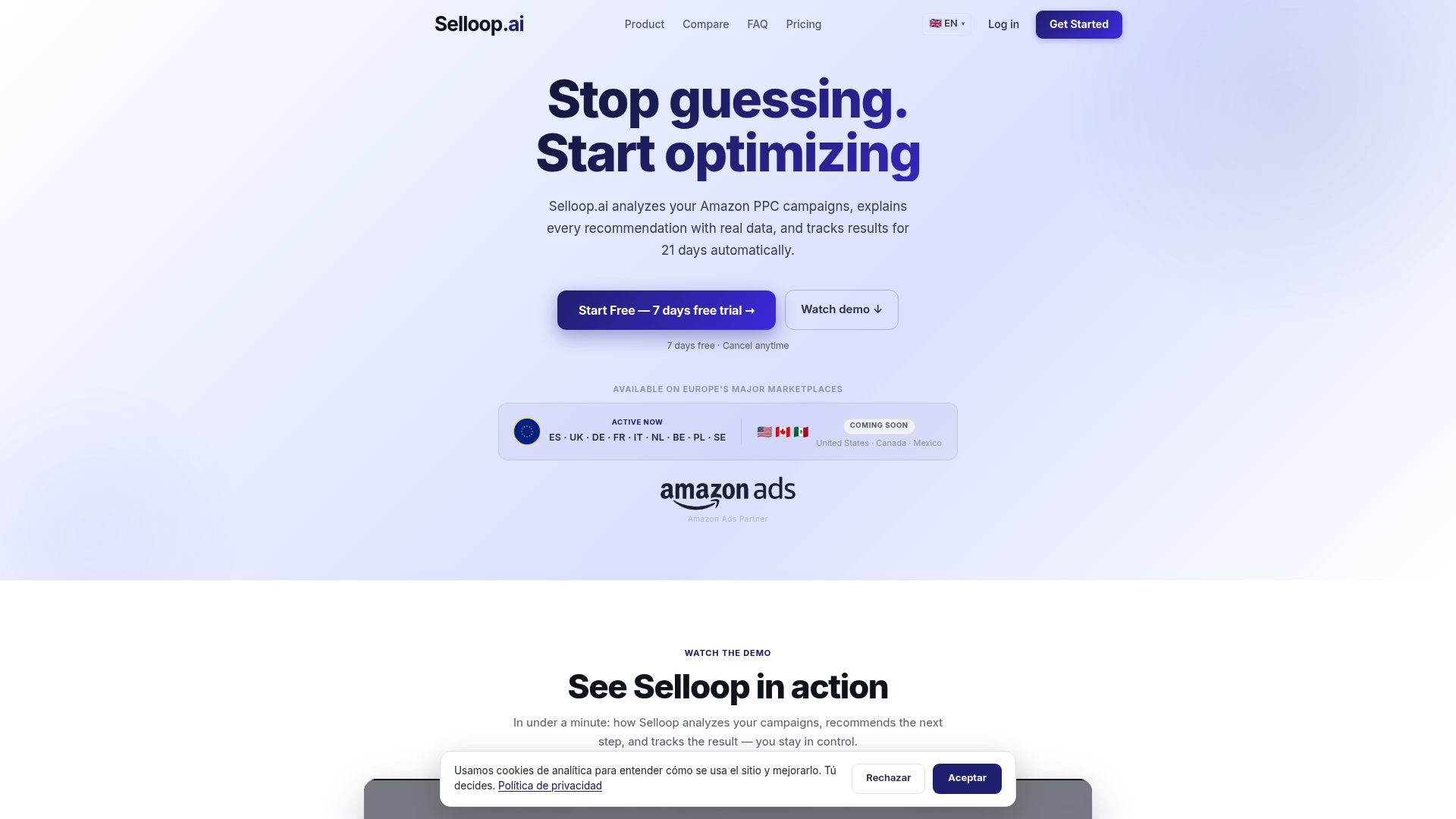
For agencies managing multiple client accounts, Selloop’s multi-account structure keeps campaigns organized without requiring a separate login per client. Plans start at €29/month with a 7-day free trial, which puts it in a different category from enterprise tools that require a sales call before you see a price.
| Feature | Selloop |
|---|---|
| Performance tracking window | 21 days per change |
| Recommendation transparency | Data-justified per action |
| Optimization profiles | Conservative, balanced, aggressive |
| Campaign types covered | Sponsored Products, Sponsored Brands |
| Multi-account support | Yes (agency-ready) |
| Free trial | 7 days |
| Starting price | €29/month |
Pro Tip: Use Selloop’s campaign health scoring on your first login to identify which campaigns are consuming budget without returns. That single report often surfaces 2–3 immediate fixes before you’ve touched a single bid.
Selloop was built by Luis Luengo, an Amazon seller with 10+ years of experience across European marketplaces. That background shows in the product: the recommendations are framed the way a seller thinks, not the way an ad platform engineer thinks.
Selloop is the affordable alternative to enterprise PPC tools
If you’ve read through this comparison and found yourself priced out of the enterprise tier or underwhelmed by the beginner tools, Selloop is worth a closer look.
The enterprise platforms in this list — Pacvue, Perpetua, Quartile — are genuinely excellent for the sellers they’re built for. But they’re built for teams with dedicated ad operations, six-figure monthly budgets, and the bandwidth to configure complex automation rules. Most Amazon sellers aren’t there yet.
Selloop gives you AI-driven PPC optimization with the kind of transparency that enterprise tools often skip: every recommendation is explained, every change is tracked, and you stay in control of what gets applied. No black-box algorithms, no guessing whether the AI is actually helping. The 7-day free trial requires no credit card, and the Amazon ad optimization starts on day one.
For sellers comparing their options across the top Amazon PPC alternatives, Selloop consistently stands out on price-to-capability ratio for the SMB segment. It’s not trying to compete with Pacvue. It’s trying to give the seller spending $5K–$50K per month on ads the same quality of AI analysis that enterprise sellers pay ten times more for.
Key Takeaways
The best Amazon PPC AI software matches your ad spend level and automation needs — beginners need simplicity, enterprises need granular AI control, and SMBs need affordable tools that actually explain their recommendations.
| Point | Details |
|---|---|
| AI vs. rule-based automation | AI-driven tools predict bid changes before performance drops; rule-based tools react after the fact. |
| ACoS improvement potential | AI-powered tools can reduce ACoS by 25–40% and help scale ad spend two to three times faster than manual management. |
| Seller size determines tool fit | Beginners suit Jungle Scout or AdBadger; enterprises need Pacvue, Perpetua, or Quartile. |
| Transparency matters | The best tools explain each recommendation with data, so sellers approve changes with confidence. |
| Selloop for SMBs | Selloop offers AI-driven optimization with 21-day result tracking, starting at €29/month with a 7-day free trial. |